
 blog
blog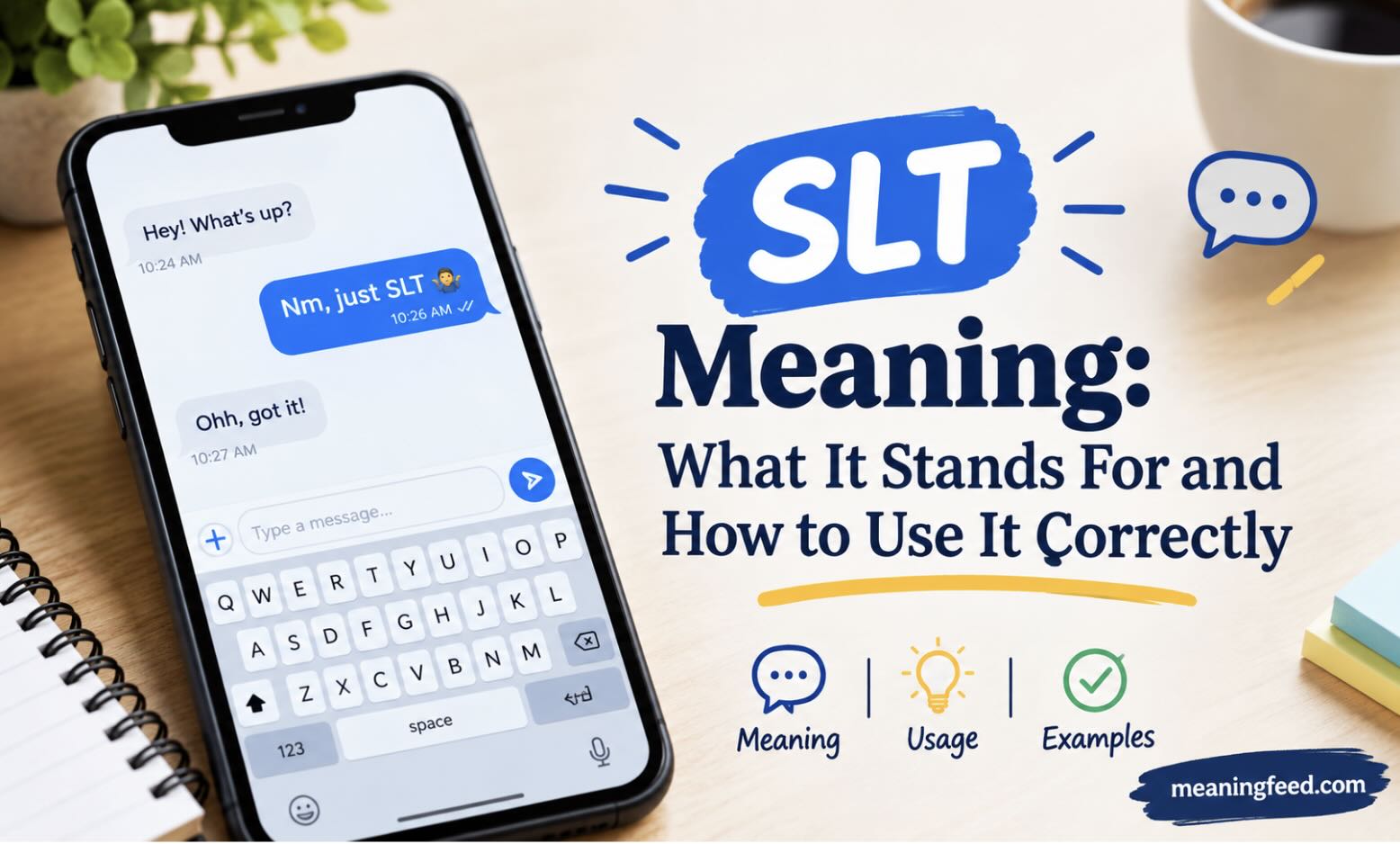
- Published by: Tutor City
- October 05, 2026
- Education
SLT Meaning: What It Stands For and How to Use It Correctly
You see "SLT" in a text message, a school email, or a medical letter, and you can't tell whether it's slang, a job title, or a treatment. That's normal. The SLT meaning changes depending on where you find it, and guessing wrong can lead to confusion or an awkward reply.
Abbreviations are useful because they save time and space. The downside is that the same few letters often stand for completely different things in different fields. SLT is a good example. A teenager in France, a UK headteacher, a speech therapist, and an eye surgeon would each give you a different answer, and all of them would be right.
This guide covers the most common definitions, shows how to tell them apart, and gives you practical habits for decoding any abbreviation you meet.
What Does SLT Mean?
There is no single answer. SLT is a short abbreviation, and short abbreviations tend to collect many meanings over time. If you want a quick overview of the different meanings of SLT, the main ones fall into four areas: texting, education and workplaces, healthcare, and business or technology.
Here is a quick summary before we go through each one in detail:
-
Texting: a casual French greeting, short for "salut"
-
Education and business: Senior Leadership Team
-
Healthcare: speech and language therapy (or therapist), and selective laser trabeculoplasty
-
Other uses: Sri Lanka Telecom, situational leadership theory, social learning theory, and more
SLT Meaning in Texting and Social Media
In casual messaging, SLT is usually a shortened form of the French word "salut." It works as a quick greeting, similar to "hi" or "hey" in English.
French speakers use it constantly on WhatsApp, Instagram, Snapchat, and in group chats. Dropping the vowels is typical of text-speak in many languages, and "slt" is simply the fastest way to write the word on a phone.
You might see messages like:
-
"Slt, ça va ?" (Hey, how's it going?)
-
"Slt tout le monde !" (Hi, everyone!)
-
"Slt, t'es dispo ce soir ?" (Hey, are you free tonight?)
Is "Slt" Formal or Informal?
It is informal. Friends, classmates, and people of the same age use it freely. In a professional email, a French speaker would normally write "Bonjour" instead. The same applies if you're replying to someone you've just met or to a person in authority.
How to Reply
If someone sends you "slt," a friendly "salut," "hey," or "hi" works well. If you don't speak French, there's no need to worry. A simple greeting in return is enough to keep the conversation going.
SLT Meaning in Schools and Workplaces
If you're reading something from a British school or a UK organisation, SLT almost always means Senior Leadership Team. This is the group of people responsible for the major decisions of an institution.
In a school, the SLT usually includes the headteacher, deputy and assistant heads, and sometimes the business manager or other senior staff. In a company, the term describes the executives or senior managers who set direction, manage resources, and oversee performance.
You'll often see it in sentences such as:
-
"The SLT will review the new attendance policy next week."
-
"Please send your concerns to a member of the SLT."
-
"Our SLT meets every Monday morning to plan the week."
What Does an SLT Actually Do?
The exact duties depend on the organisation, but a senior leadership team typically handles:
-
Setting long-term goals and strategy
-
Approving budgets and major spending
-
Creating and reviewing policies
-
Managing staff, performance, and wellbeing
-
Communicating decisions to parents, employees, or stakeholders
If you work in a UK school, you'll hear the phrase constantly. Staff meeting minutes, inspection reports, and newsletters all refer to "the SLT" as shorthand for the top level of management.
SLT Meaning in Healthcare
Medical settings give SLT two common meanings, and they have nothing to do with each other.
Speech and Language Therapy
In the UK, SLT can refer to speech and language therapy, or to the therapist who provides it. These professionals work in hospitals, schools, clinics, and community services. They help children and adults with:
- Speech sounds and pronunciation
- Language development and understanding
- Stammering or stuttering
- Voice problems
- Swallowing and feeding difficulties
- Communication after a stroke, brain injury, or illness
A school letter saying "your child has been referred to SLT" is about this type of support. It usually means a specialist will assess how the child speaks, understands, or communicates, and then suggest a plan.
In the United States, the profession is more commonly called speech-language pathology, and the professional is an SLP. That is why you'll see "SLT" mainly in British, Irish, and Commonwealth contexts.
Selective Laser Trabeculoplasty
In eye care, SLT stands for selective laser trabeculoplasty. It is a laser procedure used to help lower pressure inside the eye, most often for people with open-angle glaucoma or high eye pressure. The laser targets the eye's drainage tissue so fluid can flow out more easily.
If the abbreviation appears in an ophthalmology report or appointment letter, this is almost certainly what it means. As with any medical procedure, an eye specialist is the right person to explain whether it suits your situation and what to expect.
Other Places You Might See SLT
A few less common uses are worth knowing:
- Sri Lanka Telecom: a major telecommunications provider in Sri Lanka
- Situational leadership theory: a management model about adapting your leadership style to the people and situation
- Social learning theory: a psychology idea that people learn by observing and imitating others
- Sony SLT: a camera line that used a translucent mirror design
- Solid Logic Technology: an older IBM circuit design from the 1960s
- Mercedes-Benz SLT-Class: a car model that was produced for several years
You are unlikely to run into most of these in daily life, but they explain why a quick search for the letters alone often returns confusing results.
How to Work Out Which SLT Meaning Applies
When the SLT meaning isn't obvious, a few quick checks usually settle it.
-
Look at the source. A school newsletter points to Senior Leadership Team. A medical letter points to therapy or laser treatment.
-
Check the language. If the surrounding message is in French, it's most likely "salut."
-
Read the sentence around it. "The SLT approved the budget" and "He has an SLT appointment on Friday" clearly mean different things.
-
Consider the sender. A teenager texting a friend and a hospital administrator writing a referral are not using the same SLT.
-
Notice the country. UK usage leans toward leadership and therapy, while French-speaking regions lean toward the greeting.
-
Ask if you're unsure. A short "Sorry, what does SLT stand for here?" is better than a wrong assumption.
Common Mistakes People Make With SLT
Because the abbreviation is so flexible, a few errors come up again and again:
- Assuming it's English slang. Many people think "slt" is an English acronym when it's often just French shorthand.
- Mixing up the medical meanings. Speech therapy and laser eye treatment are very different, so always check the department or sender.
- Using it in formal writing without explanation. Readers outside your field may not know which meaning you intend.
- Overlooking regional differences. What's standard in the UK may be unfamiliar in the US or elsewhere.
Tips for Using Abbreviations Clearly
If you write SLT yourself, a little care avoids confusion.
- Spell the term out the first time in formal writing, for example "Senior Leadership Team (SLT)."
- Avoid unexplained abbreviations in emails to people outside your field.
- Match the abbreviation to your audience. "Slt" is fine in a casual French chat but out of place in a professional report.
- Be consistent. Once you've defined SLT in a document, don't switch to a different meaning later.
- When writing for a mixed audience, add a short clarification in brackets.
Why Abbreviations Like SLT Keep Multiplying
Language naturally moves toward shorter forms. Texting, social media, and fast-paced workplaces all reward speed, so people trim words down to a few letters. The trade-off is ambiguity. With only three letters, there are only so many combinations available, and different communities end up claiming the same ones.
That is why context matters more than the letters themselves. The same three characters can be a greeting, a leadership group, a therapy service, or a medical procedure, and the clues around them tell you which one is meant.
Final Thoughts
The SLT meaning depends entirely on context. It can be a friendly French greeting, a school's leadership group, a speech therapy service, or an eye procedure. Once you know where the abbreviation appears and who is using it, the right interpretation is usually easy to spot.
For more explanations of slang, acronyms, and everyday abbreviations, MeaningFeed is a handy place to look them up when you run into a term you don't recognise.






Tutor City's blog focuses on balancing informative and relevant content, never at the expense of providing an enriching read.
We want our readers to expand their horizons by learning more and find meaning to what they learn.
Resident author - Mr Wee Ben Sen, has a wealth of experience in crafting articles to provide valuable insights in the field of private education.
Ben Sen has also been running Tutor City, a leading home tuition agency in Singapore since 2010.
