
 blog
blog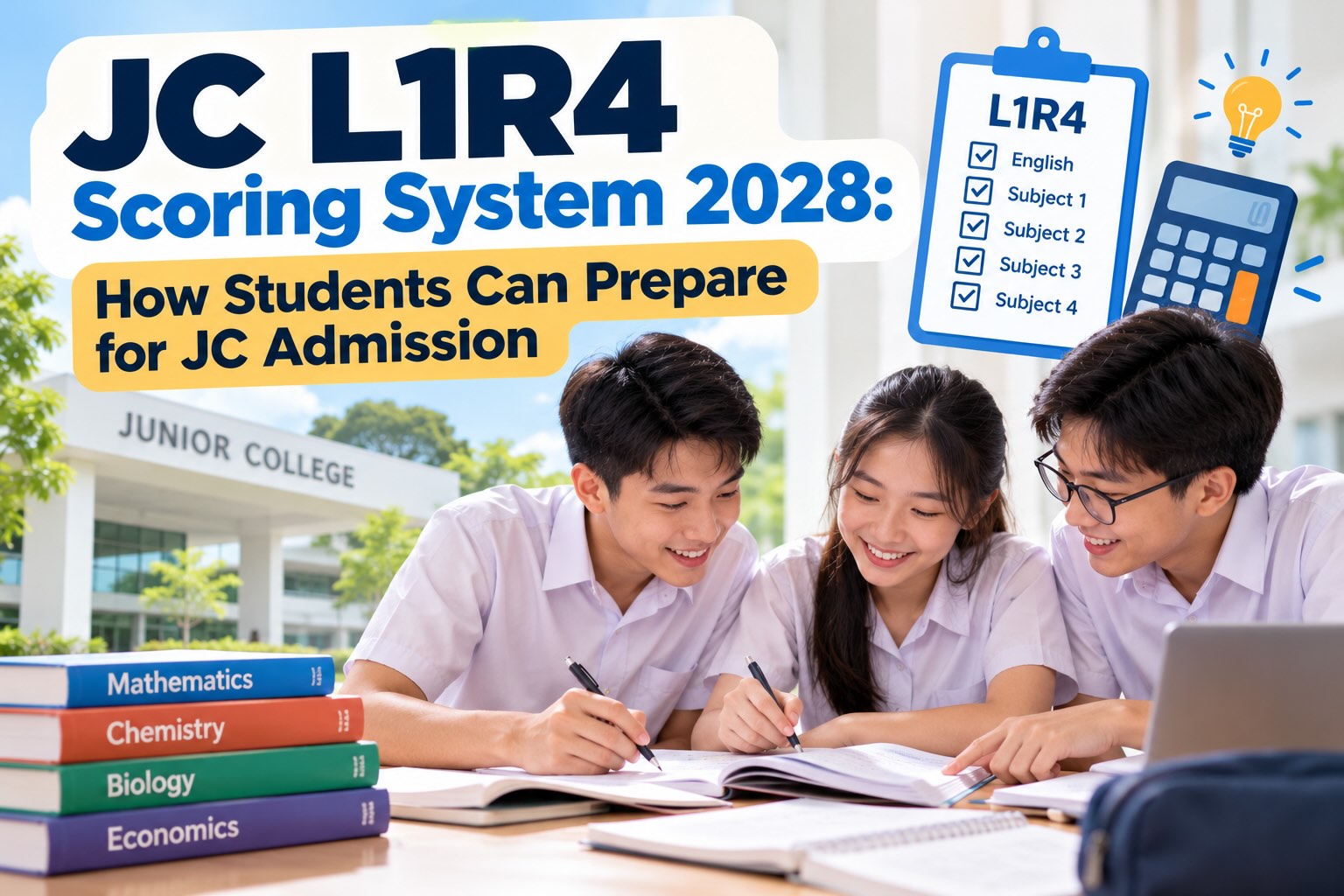
- Published by: Tutor City
- October 13, 2026
- Education
JC L1R4 Scoring System 2028: Prepare for JC Admission
From the 2028 admissions exercise onwards, a student qualifies for junior college admission with a gross L1R4 score of 16 points or fewer, provided they also meet MOE's minimum grades in English, Mathematics and Mother Tongue. L1R4 means one first language plus four relevant subjects, which is five subjects in total. It replaces the six-subject L1R5 that families have used for years.
The change affects students sitting the Singapore-Cambridge Secondary Education Certificate (SEC) examinations in 2027. They will apply through the 2028 Post-Secondary Admissions Exercise (PSE). That is the new name for the single exercise covering JCs, Millennia Institute, polytechnics and ITE.
Qualifying and getting posted are two separate steps. A gross score of 16 opens the door to JC eligibility. The net score, after bonus points, decides which JC course a student is placed in. Families who keep those two numbers apart plan with fewer surprises.
How Is the JC L1R4 Score Calculated?
The L1R4 score adds the grade points of five subjects: one first language (L1) and four relevant subjects (R1 to R4). Each slot has its own rules. The lowest valid combination counts, and lower is better.
Which Cohort Uses L1R4 Instead of L1R5?
The first L1R4 cohort is students who were in Secondary 3 in 2026. They sit the SEC examinations in 2027 and seek post-secondary places in 2028. MOE's Committee of Supply announcement confirmed that from the 2028 exercise, the subjects required for JC admission drop from six to five, with L1R5 giving way to L1R4.
Students who sit the GCE O-Level examinations in 2026 and enter the 2027 Joint Admissions Exercise (JAE) are still under L1R5. Parents with children in both cohorts should keep the two formulas separate.
A note on terminology helps here. The original announcement refers to the "2028 JAE". MOE's current admissions pages call it the 2028 PSE. Both labels describe the same exercise for 2027 SEC candidates. The PSE also reflects Full Subject-Based Banding, where subjects are taken at G1, G2 or G3 levels. JC admission is calculated on G3 subjects. Families new to the banding system can read more about subject-based banding.
Which Subjects Fill L1 and the Four Relevant Slots?
L1R4 still requires two languages and three subjects drawn from the Mathematics/Science and Humanities groups. Social Studies, paired with Geography, History or Literature, remains part of the Humanities requirement. MOE's worked examples use these slots:
| Slot | What can fill it |
|---|---|
| L1 | English Language or Higher Mother Tongue Language |
| R1 | Best G3 Humanities subject (e.g. Combined Humanities, History, Geography, Literature) |
| R2 | Best G3 Mathematics or Science subject (e.g. Elementary Mathematics, Additional Mathematics, Physics, Chemistry, Biology, Combined Science) |
| R3 | Best remaining G3 Humanities, Mathematics or Science subject |
| R4 | Best remaining G3 subject of any kind, including Mother Tongue, Art, Music or Design & Technology |
Two exceptions catch students out. Chinese Language and Higher Chinese Language cannot both appear in the same computation. If Higher Chinese is L1, the O-Level Chinese grade is excluded. Also, an O-Level Mother Tongue taken in Secondary 3 in 2026 can be combined with 2027 SEC results.
How Do You Calculate a Gross Score from Your Grades?
Each grade converts to points: A1 is 1, A2 is 2, B3 is 3, and so on to F9 at 9. Add the five chosen grades to get the gross aggregate score.
MOE's own example uses a student with six G3 subjects:
- English Language: C6 (6 points), used as L1
- Humanities: A1 (1 point), used as R1
- Mathematics: A1 (1 point), used as R2
- Science: B3 (3 points), used as R3
- Chinese Language: A1 (1 point), used as R4
- Higher Chinese: B4, not used
That gives a gross L1R4 of 12 points (6 + 1 + 1 + 3 + 1). When the same student uses Higher Chinese as L1, English moves to R4 and Chinese Language drops out, giving 15. MOE uses the better score, so 12 stands.
An L1R4 calculator speeds this up. Students should still try both L1 options by hand once, because the best arrangement is not always obvious.
What Else Determines JC Eligibility and Posting?
Eligibility rests on a gross score of 16 or below plus minimum grades in three named subjects. Posting then ranks eligible applicants by net score after bonus points. The cut-off for any specific JC course is a separate figure again.
Is a Gross L1R4 of 16 Enough to Qualify?
A gross score of 16 meets the JC qualifying aggregate, but students must also clear these subject minimums:
1. G3 English Language: A1 to C6
2. G3 Mathematics or G3 Additional Mathematics: A1 to D7
3. Mother Tongue: G3 A1 to D7, G2 1 to 5, G1 A to D, or Higher Mother Tongue A1 to E8
A student who misses one of these grades may still get conditional admission. The conditions are a gross L1R4 of 12 or below, or a score of 13 to 16 with A1 or A2 in all four relevant subjects. An "Absent" grade rules out conditional admission entirely.
Conditional entry carries a deadline. The student must obtain the required grade by the end of JC Year 1, or move to Year 2 at Millennia Institute.
How Do Bonus Points Change the Net Aggregate?
The net aggregate score is the gross score minus bonus points, and academic merit using net aggregate score remains the primary posting factor. Under L1R4, the bonus cap falls from 4 to 3 points.
In MOE's example, an "Excellent" CCA grade earned 2 points. A1 to C6 in both English and Higher Mother Tongue earned another 2. The total of 4 was capped at 3, so the gross 12 became a net 9. Affiliated JC and Language Elective Programme bonus points (including the Tamil Language Elective Programme) are considered by eligibility and course choice.
Bonus points never help a student qualify. Gross score alone decides eligibility. Students should check their CCA records with their school by September 2027.
What Is the Difference Between Eligibility and a JC Cut-Off Point?
Eligibility means a student may apply to any JC course. A JC cut-off point is the net score of the last student posted to a course in a given year. It shifts with demand and with each cohort's results.
A student with a gross 16 and a net 13 qualifies, yet may not be posted to a course whose recent cut-off sat at 8. Past JC course cut-off points were set under L1R5 and do not translate to L1R4. Results arrive in mid-January 2028, applications run for six days, and posting results follow by early February. Applicants with the same net score for the last place go through tie-breakers.
How Do Millennia Institute and Polytechnic Scores Differ?
Millennia Institute also uses L1R4 but keeps its qualifying threshold at 20 points or fewer. Its conditional admission criteria are a gross score of 15 or below, or 16 to 20 with A1 or A2 in all four relevant subjects. Its bonus cap matches the JC cap.
Polytechnic admission uses ELR2B2: English, two relevant subjects and two best other subjects. The relevant subjects vary by course, so one student holds several different polytechnic scores. Students weighing that route can read these tips for securing a polytechnic course.
How Can Students Prepare Before the 2028 Admissions Exercise?
Good preparation starts with a subject combination that fills every L1R4 slot. Next comes testing realistic grade scenarios. The steady work after that is improving weak subjects without chasing a guessed cut-off.
Choose a Subject Combination That Keeps JC Options Open
The safest combination gives at least two subjects for each relevant category. That way, one weak paper does not break the computation. A student with Combined Humanities, Elementary Mathematics, Additional Mathematics and Combined Science has a fallback in R2 and R3.
The first cohort is already adjusting. MOE told Parliament that fewer students are enrolling in Geography, Physics and Principles of Accounts, and fewer take eight or more subjects. Dropping a subject is reasonable, but students should check prerequisites first. Some A-Level subjects expect Pure Physics or Additional Mathematics. This guide to JC subject combinations shows what each stream builds on.
Use Target Grades and a Calculator to Test Different Outcomes
A JC admission calculator works best with honest numbers. Enter the latest school examination grades, then run three versions: current, realistic target and a weaker-than-expected result. Each version should be built with both English and Higher Mother Tongue as L1 where relevant.
That exercise shows which subject carries the most risk. A student at 15 with a C6 in English is close to losing eligibility. That student also sits near the English minimum, so English needs attention first.
Prioritise Improvement Without Assuming Future Cut-Off Points
The first L1R4 cut-off points will not exist until posting in 2028. Any figure quoted earlier is an estimate. Students gain more from lifting a B4 to an A2 than from predicting a target JC's number.
Targeted help suits a specific gap, such as Additional Mathematics problem sums or Literature essays. Some families use JC tuition later to manage the jump to A-Levels. Learning centres such as Ancourage Academy also run secondary programmes. The choice should follow a clear weakness from the grade scenarios.
Plan for Five Strong Subjects, Not Just a Lower Score
L1R4 counts five subjects, and every one of them carries more weight than it did under L1R5. A student needs a gross score of 16 or below plus the English, Mathematics and Mother Tongue minimums to qualify for junior college. Posting then depends on the net score and each course's demand.
Before Secondary 4 ends, students should confirm three things:
- Their subjects can fill L1 and all four relevant slots, with a spare in R2 or R3
- Their current grades clear the specific subject minimums
- Their CCA record is accurate for bonus points
Families should revisit MOE's PSE pages in mid-2027, when 2028 course information is published. For a look at what follows the posting, these hard truths about JC life give students a realistic picture of the two years ahead.






Tutor City's blog focuses on balancing informative and relevant content, never at the expense of providing an enriching read.
We want our readers to expand their horizons by learning more and find meaning to what they learn.
Resident author - Mr Wee Ben Sen, has a wealth of experience in crafting articles to provide valuable insights in the field of private education.
Ben Sen has also been running Tutor City, a leading home tuition agency in Singapore since 2010.
