
Looking for Quality Home Tutor for Economics Tuition in Singapore?
Tutor City offers private Economics tuition for A-levels, IB and IGCSE students in Singapore. Connect with an effective Economics tutor to enhance your exam performance.



Economics Tuition in Singapore
Take control of your learning journey and score higher in H1/H2 & IB Economics with targeted 1-to-1 coaching.
Have you been seeking…
- An experienced Economics tutor who simplifies complex theories & models.
- Custom lessons to fix weak topics and build confidence fast.
- Exam prep: techniques, case-study analysis, essay scaffolds & time management.
- Home/online lessons to save commute time and boost revision hours.
- Choice of qualified tutors from a pool of 20,000+.
- Fast turnaround—profiles for shortlisting & phone interview within 24h.

Benefits You Can Gain From Tutor City's Economics Tuition and Tutors
-
Maximise your child's learning potential for rapid improvement in Economics exam grades. Cut down on time and expenses while witnessing immediate academic progress through personalised one-on-one private Economics tuition. With focused attention, real-time feedback on your child's work, and concise explanations to clarify doubts, learning becomes more effective and hassle-free.
-
Empower your child with a confident mindset to conquer challenging Economics exams. Benefit from a tutor’s guidance and committed support to boost your child’s motivation and instill self-belief to sit for A-Levels Economics or IB assessments. Our Economics tutors provide mentorship and tailored exam strategies to address your child's specific weaknesses, ensuring their success and growth.
-
Unleash a stress-free, engaging, and joyful Economics learning experience. Say goodbye to rigid schedules and embrace a customised approach that caters to your child's unique learning style and preferences. Our expert Economics tutors design a learning schedule that aligns with your child's pace and needs, allowing them to absorb concepts effectively. With real-world examples and customised notes, learning Economics becomes a delightful journey at your child's comfortable pace.
-
Tap into the capabilities and client-centric service of an experienced home tuition agency. With a proven track record of over ten years meeting the unique needs of parents and students, our response is swift—within 24 hours you’ll receive a curated selection of Economics tutors who match your location, schedule, and budget for Economics tuition.
-
Find the perfect Economics tutor from our network of 20,000 private tutors. This includes school teachers, industry experts, and high-achieving students from esteemed local and international universities. Our tutors bring strong teaching experience and a solid understanding of Singapore’s Economics syllabus, ensuring your child is in capable hands.
-
Take charge of your child's Economics education journey. Make an informed decision and select the best tutor for your child—conduct phone interviews with potential tutors. Our tutor-matching service is completely free of charge. If after the initial lesson the tutor isn’t a fit, you only pay for that session and we’ll continue working to find a tutor who perfectly meets your criteria.
Why parents choose our Economics tutors
Faster gains
1-to-1 focus on weak topics; measurable improvement within weeks.
Exam craft
Answer frameworks, keywords & timing splits that convert to marks.
Real-world links
Apply theory to current issues—graphs, data and policy trade-offs.
20,000+ tutors
JC/IB specialists: MOE-trained, full-time, working pros or students.
Flexible & safe
Home or online—fit tuition around CCA and revision schedules.
Over 400 positive reviews from satisfied parents
“Engagement was positive, prompt and professional… very impressed.”
“Mr Wee’s professionalism and efficiency helped source great tutors—highly recommended.”
“Turnaround time is fast; tutors more experienced than other agencies.”
See more Google reviews.
How much does Economics tuition cost in Singapore?
Typical range $50 – $150/hour, depending on tutor credentials and level.
| Level | Part-Time tutors 1 | Full-Time tutors | Ex/Current Teachers 2 |
|---|---|---|---|
| Junior College | $50 – $60 | $70 – $90 | $100 – $150 |
| IB & IGCSE | $50 – $60 | $70 – $90 | $100 – $150 |
| Degree & Diploma | $60 – $80 | $90 – $120 | $120 – $150 |
1) Includes students in universities and graduates tutoring part-time.
2) For degree/diploma, “teachers” refers to lecturers in private or government universities.
Choose the tutor profile that fits your budget and goals; we’ll shortlist options quickly.
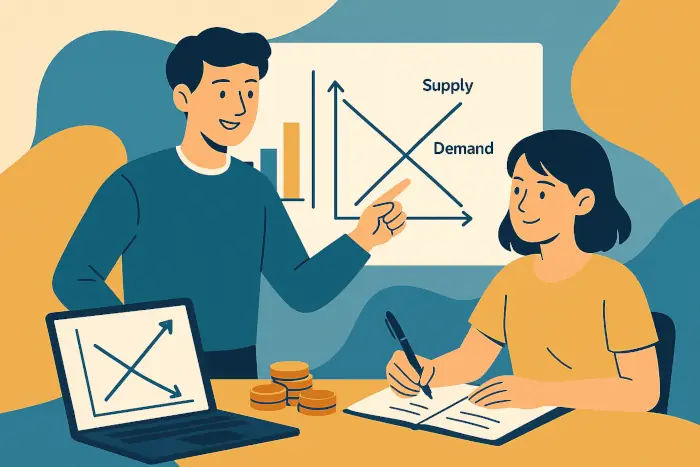
Our Economics tutors cover
- JC H1/H2/H3 A-Level Economics
- IBDP Economics SL/HL
- IGCSE / IP Economics
- Polytechnic & University modules
- Private JC Economics tuition
- Exam skills: case studies, essays, data response & evaluation
How does home tuition solve common Economics struggles?
Many students meet Economics for the first time in JC/IB. Beyond knowledge, exams demand application, evaluation and synthesis. Private tuition bridges the gap.
A-levels and IBDP Economic assessments have moved beyond mere knowledge retention and regurgitation of memorised information during exams. Instead, your child needs to display “higher order” Economics skills such as evaluation, synthesis, application and analysis during assessments to achieve good grades. On top of that, your child needs to be sharp and provide quality answers that directly address the exam questions.
We have identified the most common challenges faced by students and our Economic tutors have adopted tailored teaching approaches to address them effectively.
- Keeping up with fast syllabus pace
- Analysing case studies & data
- Graph skills & elasticity/market-failure math
- Constructing coherent essays
- Micro ↔ Macro integration
- Time management & question selection

How our tutors help (at a glance)
Bridge fundamentals fast. Solidify core theory so advanced topics stick.
Case-study playbook. Identify issues, deploy concepts, evaluate trade-offs & conclude.
Essay scaffolds. Plan → paragraphs with evidence → evaluation for L3/L4 bands.
Timed drills & strategy. Pacing, question choice and examiner-keywords that convert to marks.
Why Economics Home Tuition is Effective
If your child has put in their best effort but feels that improvement has plateaued, private Economics tuition can be a game-changer. Here's why:
-
1) Development of case study analysis skills
An Economics home tutor helps develop the critical thinking and analytical skills required for case study analysis and application to real-world issues. Students get tailored guidance to identify relevant concepts, evaluate options, and make sound decisions based on principles—then apply them across topics.
-
2) Hone essay writing skills and techniques
One-to-one tuition provides instantaneous, constructive feedback to pinpoint weaknesses, with specific advice on structure, argument development and evidence-based reasoning—reducing fear and boosting confidence for essay-based questions.
-
3) Customised Economics learning materials
Experienced tutors curate resources from different schools: practice papers, model answers, current-affairs readings, opinion pieces and reference books—exposing students to diverse perspectives and deepening understanding.
-
4) Effective learning strategies for content & concepts
Experts break down complex concepts and reveal interconnections between issues. Revision techniques—chunking big topics and using mnemonics—improve retention for exams.
-
5) Learn at your child’s pace
Each session customises method, pace and content to the learner’s needs, creating an enjoyable experience with clearer, more effective absorption of concepts.
-
6) Time management techniques
Tutors run timed past-paper drills to benchmark pacing and correct over-spending on low-yield parts. Students finish within the allocated time with a review window—using tips, tricks and tools to work efficiently.
-
7) Mentoring and advice
Tutors guide subject selection and university pathways, align interests with goals, and coach habits for success—perseverance, goal-setting and productivity—beyond academics.
What is the importance of Economics Tuition?
The majority of students meet Economics at pre-university level. It’s a useful, captivating subject that deepens real-world understanding and enables informed decisions about life and society.
In the syllabus, students study supply and demand, prices and benefits—explaining financial markets, business operations, policy and global issues. They also learn personal finance (budgeting, saving, investing, choices).
However, many new JC students struggle to grasp complex concepts and see topic interconnections. Private tuition adds case studies, practical illustrations and real-world applications to clarify misconceptions.
Some students need help with critical analysis, mathematics or essay writing. These skills require methodical approaches (e.g., essay structure for scoring). Without expert diagnosis and guidance, progress is slow and lonely.
MOE Economics Curriculum
In Singapore’s Junior Colleges, Economics (H1, H2, H3) develops decision-making via objective, sound reasoning. Emphasis is placed on “critical and inventive” skills: information handling, analysis, evaluation and judgement.
Content spans domestic, regional and global issues as context for (i) economic concepts, (ii) theories & principles, and (iii) tools for analysis. Students familiarise themselves with economic agents—consumers, firms and governments—at micro and macro levels.
A Level H2 Economics Exam Format
- Paper 1 (Case Studies): Two case studies (2–3 pages of data each) with 6–7 questions; can be interdisciplinary, drawing from multiple topics.
- Paper 2 (Essays): Choose 3 of 6 questions based on real-world issues; at least one micro and one macro essay required.
JC H2 Economics Topics (Concepts & tools)
- Scarcity, choice and opportunity cost
- Production possibility curve (PPC)
- Marginalist principle
- Price mechanism; ceteris paribus
- Demand (determinants; level vs quantity change)
- Supply (determinants; level vs quantity change)
- Market equilibrium & disequilibrium
- Elasticities: PED, YED, XED, PES
- Consumer expenditure & producer revenue
- Consumer/producer surplus
- Taxes, subsidies, price/quantity controls
- MR=MC profit-max (MC rising)
- Revenue max, satisficing, market share dominance
- Total/average/marginal cost & revenue
- Economies/diseconomies of scale
- Third-degree price discrimination
- Shut-down condition; product differentiation
- Barriers to entry; competition vs collusion
- Efficiency, allocative efficiency, equity
- Market failure; deadweight loss
- MPB/MPC, MEB/MEC, MSB/MSC; social vs private optimum
- Public goods; positive/negative externalities
- Information failure; market dominance; factor immobility
- Circular flow of income
- Aggregate demand; determinants of C, I, G, (X–M)
- Aggregate supply; its determinants
- National output; general price level; multiplier
- Standard of living; material & non-material well-being
- GDP & GNI; HDI; income inequality; Gini coefficient
- Economic growth: actual, potential, sustainable, inclusive
- Employment/unemployment: demand-deficient, structural, frictional
- Price stability: demand-pull, cost-push, deflation; CPI
- Nominal vs real concepts
- Balance of trade (surplus/deficit)
- Capital flows (short-term/long-term)
- Fiscal policy; budget surplus/deficit
- Monetary policy; supply-side policies
- Globalisation; free trade; protectionism
- International & regional economic co-operation
International Baccalaureate Diploma Programme (IBDP) — Economics
Within the IBDP, Economics sits under “Individuals and Societies.” Students take either Standard Level or Higher Level. The course covers microeconomics, macroeconomics and the global economy; students apply models to real issues and compile a portfolio of three commentaries based on economic concepts.
IBDP Topics — Microeconomics
- Demand & Supply; competitive market equilibrium
- Critique of maximising behaviour (consumers/producers)
- Elasticity of demand & supply
- Role of government in microeconomics
- Market failure — externalities & common-pool resources
- Market failure — public goods
IBDP Topics — Macroeconomics & Global
- Measuring economic activity; AD/AS variations
- Macroeconomic objectives; inequality & poverty
- Demand management: monetary & fiscal policy
- Supply-side policies
- The global economy: trade benefits & protection, arguments for/against control
- Economic integration; exchange rates; balance of payments
- Sustainable development; measuring development
- Barriers to growth/development; strategies for growth/development
What are the essential skills students need to score well in Economics?
Scoring well requires more than memorising definitions—it’s about foundations, analysis, and exam craft. Use this checklist to guide study and tutoring focus.
Foundations & Data
- Strong Economics foundation—clear grasp of concepts, theories, and principles.
- Accurately read and interpret data (text, graphs, tables).
- Make sound inferences from information; recognise limits and assumptions.
Application & Evaluation
- Apply relevant knowledge to case studies on domestic & global issues, policies, and perspectives.
- Filter what’s relevant; spot assumptions and biases quickly.
- Use higher-order thinking to evaluate and critique issues, perspectives & policy choices.
- Synthesise viewpoints into mature, well-reasoned judgements backed by evidence/examples.
Writing & Exam Craft
- Formulate coherent, structured, objective essays with clear arguments.
- Analyse questions correctly—select suitable prompts; avoid misinterpretation.
- Use answering techniques that deliver key points for marks; stay on-point.
- Manage time effectively across sections and question weights.
Why classroom time is simply not sufficient to score well in Economics exams
When it comes to achieving excellent results in A-Levels or IBDP Economics assessments, students must invest significant time in nurturing the essential skills listed earlier (foundations, data/graph literacy, application, evaluation, and exam craft). Simply relying on practising past-year questions won’t suffice—especially if there are gaps in knowledge or difficulties with structuring well-reasoned arguments in essays.
-
1) Breadth & depth outrun class time. The Economics syllabus covers a wide range of theories, models and concepts. Classroom time alone is often not enough to delve deeply into learning. Students are frequently told to catch up on readings and research at home; without discipline, they fall behind.
-
2) Past papers ≠ mastery. If your child has substantial content gaps or struggles with essay construction and argumentation, drilling papers alone won’t address root issues. Students can feel overwhelmed by the volume of content and unsure where to start or which examinable concepts to prioritise—especially while juggling other A-Level/IB subjects.
-
3) Stress & prioritisation challenges. Heavy homework loads plus the breadth of Economics cause extreme stress. Many learners don’t know how to triage topics, build revision plans, or translate notes into high-yield exam answers—leading to stalled progress.
-
4) Private tuition as a “sherpa”. Hiring a private Economics tutor is like having a mountain guide on a tough ascent. A tutor provides expert guidance and personalised support to navigate exam preparation—setting goals, creating study plans, imparting proven techniques, and motivating along the way. Ultimately, this targeted coaching helps students overcome learning challenges and reach their “summit”.
What extra support outside class needs to cover
- Close the core-concept gaps before paper drilling
- Prioritise examinable topics & build a realistic plan
- Coach essay frameworks: plan → argue → evaluate
- Targeted case-study methods & graph/data fluency
- Timed practice with pacing & review buffers
- Ongoing motivation + accountability to sustain progress
Economics tutors in Singapore: The different profiles
Are you familiar with the different categories of Economics home tutors in Singapore? Each profile has distinct advantages and disadvantages that can impact your child’s learning experience. Use this guide to understand strengths and trade-offs.
Full-time Economics Home Tutors
Full-time tutors dedicate their careers to private Economics tuition (often 40+ hours/week), teaching tertiary students of varied abilities and schools. Most hold Bachelor’s/Master’s degrees in Economics, Business or Finance, combining strong content mastery (theories, principles) with accumulated tutoring techniques, lesson planning and assessment skills for clear, engaging delivery.
They routinely incorporate extra learning materials (news articles, model essays, academic readings), communicate well, and build rapport/continuity across academic levels—reducing student switching and strengthening progress over time.

Advantages
- Years to decades of experience with IBDP, JC and A-Level syllabi.
- Customises materials and approach to individual learning styles.
- Clear explanations of complex concepts; anticipates misconceptions.
- Brings curated resources (notes, readings, model answers).
- Reliable scheduling; strong rapport and long-term continuity.
Disadvantages
- Higher hourly rates than part-time tutors.
- Time invested in planning/research and proprietary materials raises cost.
- Popular tutors have limited availability; peak slots fill quickly.
Working Professionals — Economics Part-time Tutors
These tutors balance a full-time career with home tuition. Backgrounds vary (including ex-JC/international/centre teachers), bringing diverse real-world perspectives into lessons.
Advantages
- Quality lessons at more affordable rates than MOE-trained or full-time tutors.
- Real-world applications spark interest and deepen understanding.
- Many have strong curriculum familiarity and positive testimonials.
- Good cost–quality balance for multi-subject households.
Disadvantages
- Limited slots (after-work/weekend); occasional rescheduling.
- May need closer coordination to match school objectives/topics.
- Often not formally teaching-certified; may lag on latest syllabus changes without proactive updates.
Student Economics Part-time Tutors
Comprises university/Master’s/PhD students (commonly in Economics/Business/Finance). The close age gap often yields energetic, empathetic teaching and quick rapport.
Advantages
- Most cost-effective option; many achieved excellent grades themselves.
- Recent A-Level/IB experience → relevant exam tips and empathy.
- Flexible scheduling; easy to arrange make-ups or term-break intensives.
- Useful mentoring and emotional support for anxious learners.
Disadvantages
- No formal teaching certification; 1–4 years average tutoring experience.
- May struggle with a wide spread of student profiles without guidance.
- Exam/CCA commitments constrain availability; requires flexibility.
- Engage a reputable agency to screen commitment and verify credentials.
MOE-Trained Economics Home Tutors
Includes current MOE teachers (with principal approval) and ex-MOE teachers. NIE-trained professionals with JC classroom and assessment experience.
Advantages
- Deep syllabus expertise; insight into paper setting and marking.
- Pinpoints high-yield focus areas (e.g., essay techniques to stand out).
- Effective strategies for weaker students; faster grade lifts possible.
- Large classroom exposure → tested, impactful instruction.
Disadvantages
- Highest hourly rates among all profiles.
- Limited supply due to 2021 public-service regulations (approval required).
- Slots scarce; scheduling can be challenging during peak periods.
Different Types of Economics Tuition in Singapore
Each mode offers distinct trade-offs in cost, flexibility, and personalisation. Use this overview to choose what fits your schedule, budget, and learning goals.
-
1) Economics tuition in the tuition centre
- Group classes (≈6 to 30+ learners) on a fixed schedule at a physical location.
- Some centres specialise solely in Economics—strong focus on curriculum, teaching strategies and tailored materials.
- Less freedom to choose a specific tutor/timeslot; popular classes fill fast → potential waitlists.
- Commute time adds friction; make-up lessons can be hard due to room and class availability.
-
2) Home Economics tuition
- Personalised 1-to-1 at your home or the tutor’s; flexible timeslot that suits both parties.
- Different skill set from classroom teaching—strong interpersonal pacing for weaker learners.
- Patient, iterative explanations until concepts click; questions welcomed freely.
- Private setting builds rapport and credibility, boosting enjoyment and confidence.
-
3) Private small-group Economics tuition
- 2–4 friends/classmates share a session at the tutor’s place or a co-working space (cost sharing).
- Discussion-driven learning—exchange ideas, challenge viewpoints and deepen understanding.
- Interactive setting increases motivation and engagement; learners look forward to sessions.
-
4) Online Economics tuition
- Post-COVID staple offered by centres and private tutors—great when commute/scheduling is tight.
- Useful if a tutor can’t slot travel between lessons or when minimising contact near major exams (e.g., A-Levels).
- Retains 1-to-1 focus with digital whiteboards, past-paper drills and recorded feedback as needed.
How to select an Economics home tutor for tuition lessons?
Here are the most valuable qualities you should look for in an Economics home tutor—plus the support you’ll get from Tutor City.
-
1) Passion for Teaching Economics
Passion drives continuous improvement in teaching and student outcomes. Seek a JC/IB tutor who clearly shows commitment to helping students excel—through open communication, clear expectations, and willingness to align schedules and lesson goals to your needs.
-
2) Tutoring Experience
An experienced Economics tutor understands common pitfalls and the demands of each level (H1/H2/IBDP), and can adjust pedagogy to match a student’s strengths and gaps. We place strong emphasis on relevant experience when recommending tutors.
-
3) Reviews & Testimonials
Read feedback from parents and students to gauge effectiveness and style. Ask for testimonials or references—at Tutor City you can request them—to confirm fit before committing.
-
4) Continuous Learning & Improvement
Economics evolves—strong tutors stay current with research, news, and policy. Look for evidence of ongoing development (workshops, academic/industry reading, educator networks) so lessons stay relevant and up-to-date.

Support from Tutor City to select a suitable Economics tutor
- Carefully screened, highly qualified Economics tutors
- Profiles within 24 hours after your tutor request
- Arrangement of phone interviews with shortlisted tutors
- Free consultation on requirements and suitable profiles
- Follow-up after first lesson for feedback & adjustments
- Easy change of tutor if unsuitable (only lessons taught charged)
- 100% no agency fee to parents/students
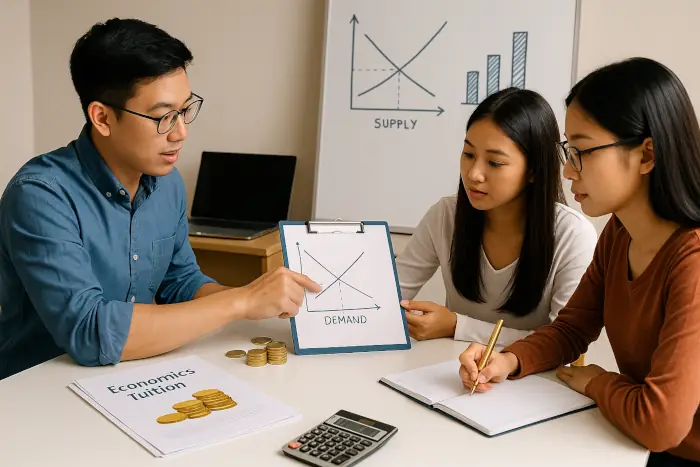
Tutor City: Singapore’s premier Economics tuition agency
We save parents time with fast, friendly matching—thoroughly screened tutors across all budgets and locations.
Submit a tutor request form and get curated profiles within 24 hours.
Read also
Google Verified Reviews From Our Clients
FAQ
