
 blog
blog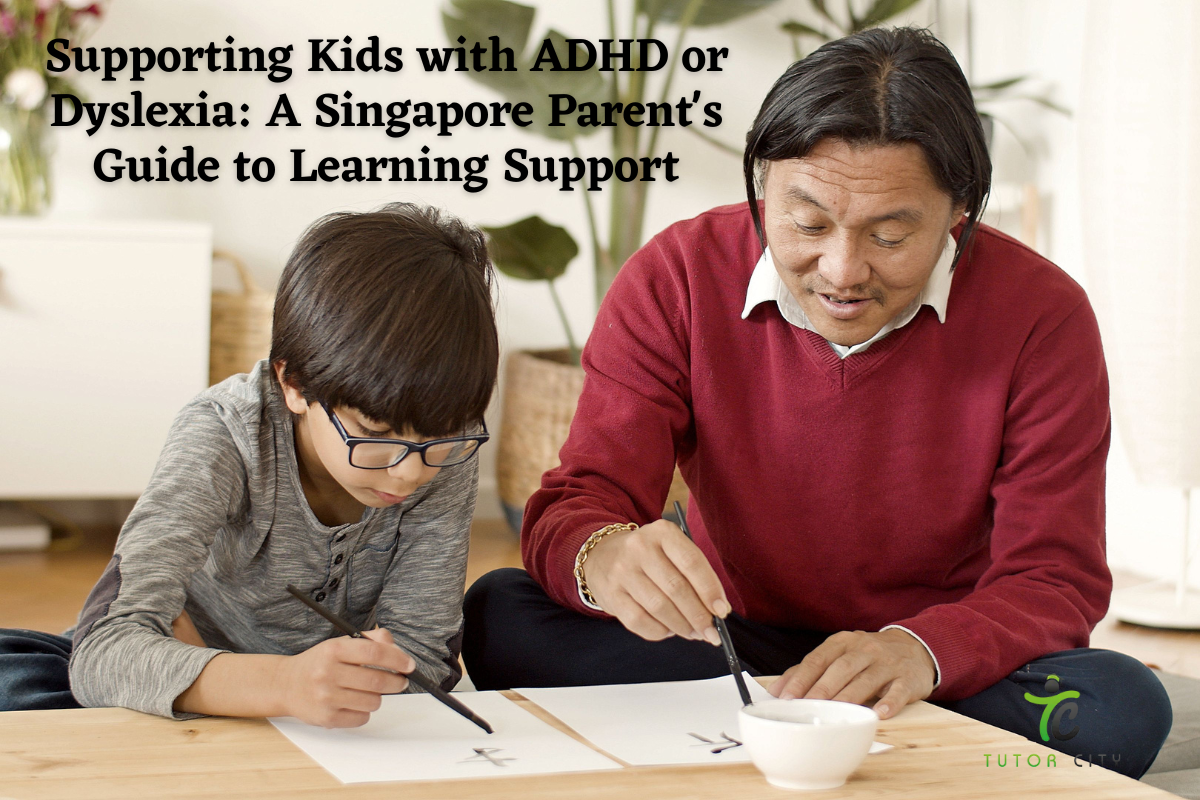
- Published by: Tutor City
- August 27, 2026
- Education, Parenting
Supporting Kids with ADHD or Dyslexia: A Singapore Parent's Guide to Learning Support
For many Singapore parents, the moment a teacher first mentions "learning difficulties" during a parent-teacher meeting can feel disorienting. Is it a phase? Is it serious? What happens next? The truth is that ADHD (Attention-Deficit Hyperactivity Disorder) and dyslexia are among the most common learning-related conditions affecting school-going children here, and neither one reflects a child's intelligence or effort.
The numbers make this clear. According to the Ministry of Education's own parliamentary reply, about 3.5% of Primary 3 students in Singapore have been identified as having dyslexia, with roughly 1% of Secondary 1 students diagnosed figures that sit comfortably within the international prevalence range of 3% to 10% (Ministry of Education). ADHD is even more widespread: research cited by the Ministry of Health puts the prevalence among children and adolescents at 5% to 8%, compared with 2% to 7% in adults (Ministry of Health). In a class of 30 students, that means it is statistically likely that at least one or two children are quietly navigating one of these conditions every single day.
What this means practically is that ADHD and dyslexia are not rare, mysterious diagnoses, they are common enough that most schools, tutors, and paediatric clinics in Singapore have well-established pathways for identifying and supporting them. Yet many parents still hesitate to raise concerns, worried that a label will get attached to their child, or that difficulty somehow reflects poorly on their parenting. In practice, the opposite tends to be true: children whose learning differences are named and addressed early usually build stronger self-esteem than those who spend years quietly wondering why schoolwork feels harder for them than for their classmates.
This guide walks through what these conditions look like day to day, what support already exists within the Singapore system, and how parents can build a home environment, and choose the right tutoring support that helps a child thrive rather than just cope.
Understanding ADHD and Dyslexia in the Singapore Classroom
Before deciding on any intervention, it helps to understand what these two conditions actually look like in practice, since they are frequently confused with each other or dismissed as "bad behaviour" or "laziness."
What Dyslexia Looks Like in the Classroom
Dyslexia is a specific learning difficulty that primarily affects reading fluency, spelling, and word decoding, it is not related to a child's overall intelligence. A child with dyslexia may read slowly, reverse similar-looking letters, struggle to sound out unfamiliar words, or avoid reading aloud in class. Because Singapore's bilingual curriculum requires children to decode both English and their Mother Tongue language simultaneously, dyslexic students here often face a heavier cognitive load than peers in monolingual education systems, which is one reason local specialists pay close attention to early literacy screening.
What ADHD Looks Like at Home and School
ADHD affects executive function, the mental skills involved in planning, sustaining attention, and regulating impulses, rather than a child's willingness to behave. In the classroom this might show up as difficulty staying seated, losing track of instructions partway through, or submitting incomplete homework despite understanding the material. At home, it often looks like a child who can hyperfocus on a video game for an hour but cannot sit through ten minutes of spelling practice. These are not signs of defiance; they reflect how the ADHD brain regulates attention and motivation differently.
Why Early Identification Matters
Both conditions respond far better to support when identified early. MOE screens all Primary One students for weak literacy skills specifically so that reading difficulties, including early markers of dyslexia, can be caught before a child falls significantly behind. For ADHD, waiting until a child is failing academically often means the child has already internalised the belief that they are "bad at school", a mindset that is much harder to undo than the original attention challenge. Parents who notice persistent patterns, rather than occasional off days, should feel confident raising the issue with their child's form teacher or a paediatrician early rather than adopting a wait-and-see approach.
It's also worth noting that the two conditions can overlap. A child can be dyslexic and have ADHD at the same time, and when that happens, reading difficulties and attention challenges can compound each other in ways that are easy to misread as one problem rather than two. This is one reason a proper assessment, rather than a parent's or teacher's best guess, matters. The support strategies for each condition are different and a child who is only being treated for one may still struggle with the other.
The Learning Support System Already Available to Singapore Families
One thing many parents don't realise is that Singapore already has a reasonably structured support system in place, the challenge is usually knowing how to access it and when additional private support, such as special needs tuition Singapore programmes, becomes worthwhile alongside it.
School-Based Support: The LSP and MOE-Subsidised DAS Programmes
For literacy difficulties, MOE runs the Learning Support Programme (LSP), a school-based intervention for students with persistent reading struggles, which typically begins before a formal dyslexia diagnosis is even made. Where a child's needs are more specialised, MOE also subsidises remediation delivered by the Dyslexia Association of Singapore (DAS), a dedicated external provider (Ministry of Education). Because dyslexia itself ranges from mild to severe, the intensity of support a child receives is meant to be matched to their individual profile rather than applied as a one-size-fits-all programme.
Subsidised Clinical Support for ADHD
On the medical side, ADHD assessment and treatment in Singapore is more accessible than many parents assume. Children aged six and below can receive subsidised consultations and therapy of up to 70% through the Child Development Programme, while school-age children have access to free school-based interventions alongside subsidised specialist care, also at up to 70%, through public healthcare channels (Ministry of Health). Families facing financial difficulty even after subsidies can also look into MediFund. In practice, this means the biggest barrier for most families isn't cost, it's simply not knowing that a polyclinic referral to a paediatrician or child psychiatrist is often the fastest way into this system.
How Parents Can Reinforce Learning Support for Kids at Home
School-based and clinical support form the foundation, but the day-to-day reality of homework battles, exam stress, and confidence-building largely plays out at home, which is where consistent, well-matched learning support for kids in Singapore really makes a difference.
Practical Strategies Parents Can Use Daily
For a child with dyslexia, breaking reading into shorter, structured sessions tends to work better than long unstructured reading time, and using audiobooks alongside physical books can keep a child engaged with story content even while their decoding skills are still developing. For a child with ADHD, homework often goes more smoothly when broken into short blocks with clear start and end points, paired with a visible timer or checklist, rather than expecting sustained, unbroken focus. In both cases, consistency and predictable routines tend to matter more than any single technique, children with these profiles often do better when they know exactly what's expected of them and when a task will end.
Praise also needs to be recalibrated. A child with dyslexia or ADHD often hears far more correction than praise over the course of a school day simply because their difficulties are more visible than a typically developing peer's. Actively noticing and naming effort, not just correct answers, helps counter the discouragement that can build up quietly over months of feeling "behind." Small, specific feedback ("you stuck with that paragraph even though it was hard") tends to land better than generic encouragement, because it shows the child that their particular struggle was actually seen.
What to Look for in a Dyslexia Tutor or ADHD Support Programme
Not every tutor is equipped to work with a child who has a diagnosed learning difference, and that's an important distinction for parents to check before committing. A genuinely qualified dyslexia tutor Singapore search should turn up educators with relevant training, whether that's experience from specialised schools, dyslexia-specific training institutes, or recognised certifications, rather than general tutors simply repeating the same teaching methods more slowly. Ask prospective tutors directly about their experience with your child's specific profile, and don't hesitate to request examples of how they've adapted lessons for a similar learner in the past. The right tutor won't just cover the syllabus; they'll adjust pacing, materials, and communication style to how your child's brain actually processes information.
Conclusion and Next Steps
ADHD and dyslexia are common, well-understood conditions that, with the right combination of school-based programmes, clinical support, and consistent home strategies, are very manageable. Singapore families already have structured pathways through MOE and MOH, but knowing how to layer personalised support on top of that system is often what makes the real difference to a child's confidence and progress.
If you're looking for a tutor who understands how to work with a child's ADHD or dyslexia rather than around it, TutorCity can match your family with an experienced, verified special needs tutor suited to your child's specific learning profile. Get in touch with TutorCity today to find the right learning support for your child.






Tutor City's blog focuses on balancing informative and relevant content, never at the expense of providing an enriching read.
We want our readers to expand their horizons by learning more and find meaning to what they learn.
Resident author - Mr Wee Ben Sen, has a wealth of experience in crafting articles to provide valuable insights in the field of private education.
Ben Sen has also been running Tutor City, a leading home tuition agency in Singapore since 2010.
