
 blog
blog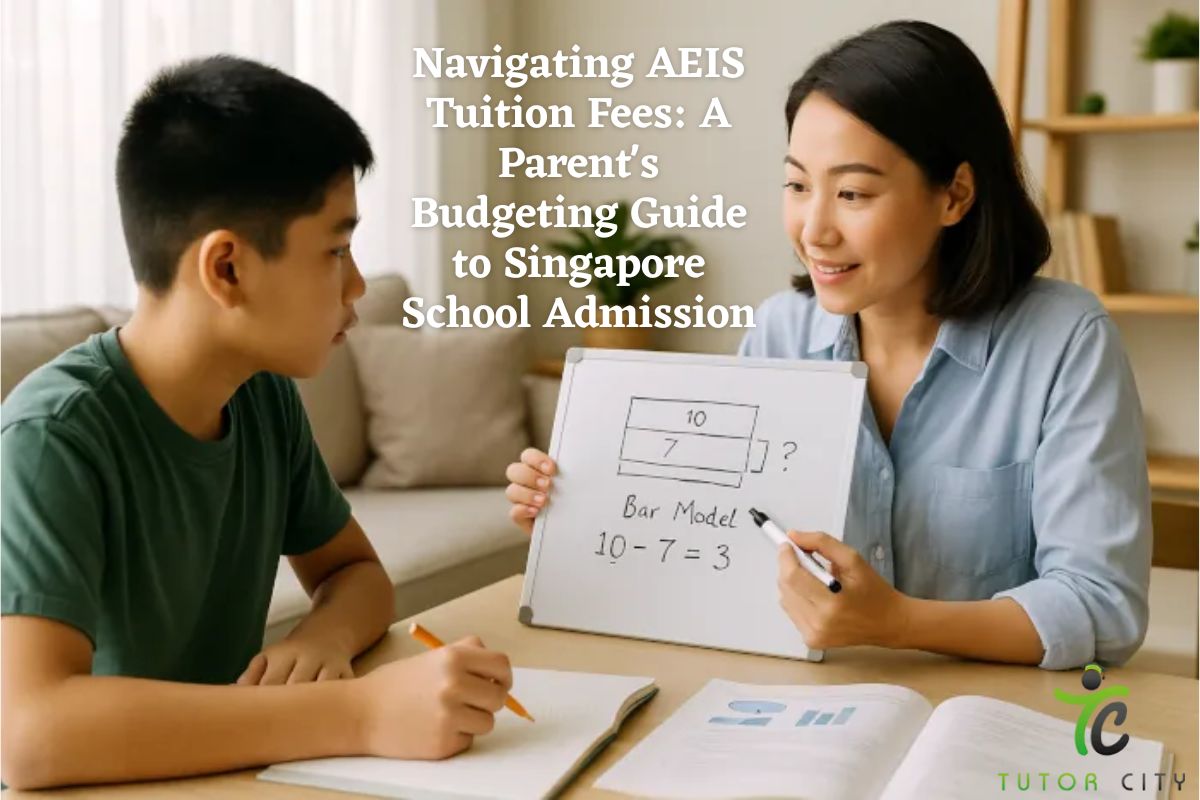
- Published by: Tutor City
- June 12, 2026
- Parenting, Education, Money
Navigating AEIS Tuition Fees: A Parent's Budgeting Guide to Singapore School Admission
Securing a coveted spot within Singapore’s world-renowned public school system is an incredible milestone for international families. Managed by the Ministry of Education (MOE), Singapore’s mainstream schools consistently rank at the top of global educational indices, such as the Programme for International Student Assessment (PISA) compiled by the Organisation for Economic Co-operation and Development (OECD). This high academic standard makes admission exceptionally competitive. For international students looking to join local primary or secondary schools, the primary pathway is the Admissions Exercise for International Students (AEIS), administered by the Singapore Examinations and Assessment Board (SEAB).
The AEIS is a centralized, high-stakes examination that assesses an applicant's English literacy and mathematical reasoning abilities. Because the test is calibrated explicitly against Singapore’s advanced, fast-paced local school curriculum, foreign applicants often face a massive culture shock when confronting the examination papers. To close this steep conceptual gap and ensure their child can compete effectively against global applicants, an increasing number of parents are choosing to invest in structured, one-on-one academic guidance. For families planning their relocation budgets, understanding the prevailing market standard for an AEIS Tutor Rate and general AEIS Tuition Fee structures is a critical first step in building a sustainable, realistic, and highly successful preparation timeline.
The Financial Landscape: Decoding Current AEIS Tuition Fees
The private home tuition ecosystem in Singapore operates on a highly transparent, market-driven framework where hourly rates scale precisely alongside an educator’s academic credentials, years of specialized curriculum exposure, and proven track record of successful school placements.
Prevailing Market Rates Across Profiles
On average, parents navigating the local tuition market can expect hourly fees to range anywhere from $30 to $100 per hour. This pricing gradient is shaped by two primary variables: the targeted grade level of the applicant (Primary versus Secondary) and the professional background profile of the tutor.
The matrix below outlines the current 2026 market standard hourly rates across various levels and educator profiles:
|
Student Level |
Part-Time Tutors ¹ |
Full-Time Tutors |
Ex / Current MOE Teachers |
|
Primary 2 – 3 |
$30 – $35 / hr |
$40 – $50 / hr |
$60 – $80 / hr |
|
Primary 4 – 6 |
$35 – $45 / hr |
$50 – $60 / hr |
$65 – $90 / hr |
|
Sec 1 – 2 |
$35 – $45 / hr |
$50 – $70 / hr |
$75 – $90 / hr |
|
Sec 3 |
$35 – $50 / hr |
$50 – $70 / hr |
$75 – $100 / hr |
Includes polytechnic students, university undergraduates, and graduates tutoring on a part-time basis.
Balancing Budget with Pedagogical Needs
When selecting an academic mentor, families must carefully weigh their financial allocation against the specific learning requirements of the student. Part-time tutors such as university undergraduates frequently offer a highly cost-effective, relatable entry point for students who simply require routine drilling and basic homework supervision.
However, full-time tuition professionals and former MOE school teachers bring deep diagnostic insights, advanced teaching methodologies, and clear experience signals to the table. These highly experienced mentors know exactly how to decode the subtle marking rubrics and complex heuristics favored by local examiners, making them a premium but necessary investment for students facing tight timelines.
Primary Level Entry: Navigating the Mandatory CEQ and Math Heuristics
The entry requirements for international primary school applicants seeking admission into Primary 2 through Primary 5 underwent a monumental structural shift that fundamentally altered how families must allocate their preparation timelines and tutoring budgets.
The Mandatory Cambridge English Qualification (CEQ) Requirement
Many families mistakenly assume that registering for the centralized MOE exam covers both core language skills and numerical abilities on a single test day. However, there is no longer a centralized AEIS English language paper for primary-level candidates during the official autumn testing window.
Instead, international primary school applicants must first sit for and clear the relevant Cambridge English Qualification (CEQ) test run by Cambridge Assessment English. This international language certification must be taken within 12 months prior to submitting the online AEIS application.
The applicant must meet or exceed the designated Cambridge English Scale (CES) score floor—utilizing the Key for Schools (A2 KET) or Preliminary for Schools (B1 PET) formats before they are legally permitted to register for the subsequent centralized Mathematics test. Specialized AEIS tuition programs actively guide families through this multi-tiered registration process, ensuring that the student achieves the mandatory language benchmark well ahead of the official MOE submission deadlines.
Mastering the Rigors of Singapore Primary Mathematics
Once the CEQ requirements are fully satisfied and uploaded to the official Candidates Portal, the primary applicant faces the centralized Mathematics paper. Singapore's primary mathematics curriculum is world-renowned for its conceptual depth, structural logic, and heavy reliance on visual model-drawing and complex heuristics.
A standard Primary 2 or 3 Mathematics paper features a rapid-fire 25-minute multiple-choice section immediately followed by a 40-minute short-answer section. For older primary tiers (Primary 4 and 5), the stakes increase significantly: a 35-minute multiple-choice portion is paired with a demanding 50-minute block dedicated entirely to complex, open-ended word problems.
Calculators are strictly prohibited across all primary testing tiers. Students are evaluated heavily on showing their structural working steps clearly. A private instructor focuses intensely on these open-ended parameters, ensuring that students learn how to construct flawless bar models and avoid losing valuable "method marks" due to skipped logical steps.
Secondary Level Entry: Conquering Combined Language and Numerical Papers
For students seeking placement into Secondary 1, Secondary 2, or Secondary 3, the evaluation process remains fully centralized under the MOE and SEAB, testing both advanced English literacy and mathematical proficiency over consecutive, intensive examination dates.
Crucial Composition Formats and Advanced Language Rubrics
The Secondary English examination is a rigorous assessment that demands native-level structural fluency, precise grammatical editing, and sophisticated vocabulary usage under intense time pressure. The paper is split into an intensive 2-hour-and-10-minute multi-part exam:
-
Part 1: Continuous Writing: Students are presented with a selection of situational, narrative, or argumentative essay prompts. The mandatory essay word limits scale precisely by the target grade level: 200 to 300 words for Secondary 1, 250 to 350 words for Secondary 2, and 300 to 400 words for Secondary 3.
-
Part 2: Comprehension and Language Use: This consists of 50 compulsory multiple-choice items spanning deep textual inference across two distinct reading passages, comprehension cloze texts, advanced vocabulary matching, and complex grammatical editing drills.
Without targeted private AEIS tuition, foreign students frequently struggle to express their ideas clearly within the structural parameters expected by local MOE markers.
Secondary Mathematics: Overcoming Abstract Concept Gaps
The Secondary Mathematics layout requires an incredibly agile mathematical mind. The examination features a rapid-fire 30-minute multiple-choice component, which is immediately followed by an intensive 1-hour-and-45-minute section comprising 20 short-answer questions and 10 to 15 highly complex, open-ended problem-solving items.
Calculators remain strictly prohibited throughout the entire test. The testing scope expands far beyond basic arithmetic to include complex algebraic manipulations, simultaneous equations, formal geometric proofs, statistical analyses, and non-routine logic modeling.
Foreign candidates routinely experience intense exam anxiety due to unfamiliarity with local question phrasing, such as "total did not change" or "common units" modeling techniques. Investing in a structured educational pathway ensures that these conceptual gaps are systematically identified and resolved.
The Strategic Preparation Blueprint: Maximizing Success
Earning a competitive score on the centralized assessment requires an analytical, long-term preparation approach that extends far beyond standard rote memorization or last-minute cramming. Expert academic mentors recommend initiating structured preparation cycles a minimum of twelve months prior to the target exam window.
[12 Months Out] Early Diagnostic Testing & Content Gap Mapping
│
▼
[9 Months Out] Focused Topic Mastery & Local Heuristics Training
│
▼
[6 Months Out] Mandatory Primary CEQ Sittings / Secondary Essay Pacing
│
▼
[3 Months Out] Strict Timed Simulation & Strict Error Log Audits
1. Conducting Comprehensive Diagnostic Assessments
The first step in a successful preparation timeline must always involve identifying exact curriculum disparities. The exam content is calibrated explicitly to the specific syllabus taught in Singapore public schools during the academic year preceding the target entry grade.
For example, an international student attempting entry into Secondary 3 is tested entirely on the core Secondary 2 curriculum. An initial diagnostic assessment isolates exactly which mathematical concepts, algebraic procedures, or linguistic formats require immediate attention, allowing for an efficient allocation of the tutoring budget.
2. Sourcing Authentic, MOE-Aligned Learning Materials
A common pitfall for international families is relying on generic international school curricula or regional assessment workbooks purchased online. Singapore’s local assessment models are highly distinct and require specialized practice.
Dedicated home educators bypass generic materials to build lesson structures exclusively around past-year topical examination papers from top-performing local schools and official publications. This precise alignment ensures that the complexity, phrasing, and cognitive demand of the practice questions perfectly mirror what the student will face on test day.
3. Simulating Exam Conditions and Time Management
Many academically brilliant international students fail their sittings simply because they run out of time. Completing dozens of complex math word problems or drafting a cohesive 400-word essay within rigid time limits requires calculated pacing.
Private tutoring actively solves this issue by enforcing strict, timed exam simulations. Tutors teach students how to split their time effectively across sections, track optical answer sheet (OAS) shading routines without error, and identify when to temporarily skip a high-difficulty question to protect easier baseline marks.
Conclusion: Empowering Your Child for Seamless Academic Integration
Navigating the complex administrative logistics, strict grading criteria, and tight application timelines of the local educational system can be a daunting experience for any international family. However, the world-class academic foundation, multi-cultural social exposure, and long-term residency advantages of integrating into a mainstream Singapore public school make the effort incredibly worthwhile.
While securing specialized academic support involves a clear financial commitment, managing the baseline AEIS Tuition Fee effectively provides your child with personalized diagnostic roadmaps, targeted heuristics mastery, and the confidence needed to excel under pressure. Don't leave your child's educational future to chance. To find the ideal educational mentor tailored to your target grade level, study timeline, and budget, explore our customized choices and secure an experienced guide today.
Ready to secure your child’s academic future in Singapore?
At Tutor City, we specialize in pairing international students with highly experienced, curriculum-expert mentors who understand the exact nuances of the SEAB assessment criteria and the Cambridge CEQ framework. We provide highly responsive, personalized matching services across Singapore to ensure your child receives the targeted guidance they need to excel.
Connect with an expert private tutor at Tutor City today and conquer your AEIS examinations.






Tutor City's blog focuses on balancing informative and relevant content, never at the expense of providing an enriching read.
We want our readers to expand their horizons by learning more and find meaning to what they learn.
Resident author - Mr Wee Ben Sen, has a wealth of experience in crafting articles to provide valuable insights in the field of private education.
Ben Sen has also been running Tutor City, a leading home tuition agency in Singapore since 2010.
