
 blog
blog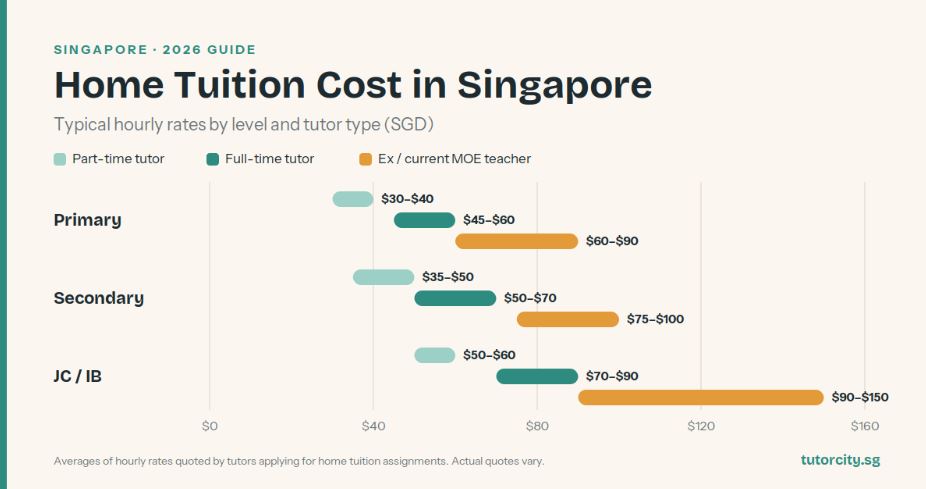
- Published by: Tutor City
- September 25, 2026
- Money
Home Tuition Cost in Singapore 2026: What Should You Really Pay?
Ask ten parents what they pay for a home tutor and you will hear ten different numbers, often for the same level and subject. One family pays $35 an hour for Primary 5 Maths, another pays $80, and both assume theirs is the normal price. The spread is real, and it is mostly explainable once you know what actually drives it.
Start with the official picture. According to the Department of Statistics' Household Expenditure Survey 2023, which covered resident households between December 2022 and December 2023, households spent an average of $104.80 a month on private tuition. Nationally, that works out to roughly $1.8 billion in 2023, up from $1.4 billion in 2018. Households in the top 20 per cent by income averaged $162.60 a month, while the bottom 20 per cent averaged $36.30.
Those averages are useful context, but they are not a price guide. The $104.80 figure is spread across every household surveyed, including the many that pay nothing for tuition. A family actually engaging a one-to-one home tutor will almost always spend well above it. This guide explains what home tuition genuinely costs in 2026, why the same lesson can be priced so differently, and where parents can save without lowering the quality of help their child gets.
Private Tutor Rates in Singapore 2026: What the Numbers Look Like
Hourly Rates by Level
The ranges below come from the asking rates quoted by tutors applying for home tuition assignments through Tutor City. We do not set these rates; tutors are freelance and name their own fees, so treat these as market averages rather than fixed prices.
|
Level |
Part-time tutors |
Full-time tutors |
Ex/current teachers |
|
Pre-school |
$30–$35 |
$40–$45 |
$50–$60 |
|
Primary |
$30–$40 |
$45–$60 |
$60–$90 |
|
Secondary |
$35–$50 |
$50–$70 |
$75–$100 |
|
JC / IB DP |
$50–$60 |
$70–$90 |
$90–$150 |
For the complete breakdown, including degree, music and adult language lessons, our page on private tutor rates in Singapore for 2026 is updated as asking rates shift.
Why Tutor Type Moves the Price More Than Level
Look across any row of that table and the gap between tutor categories is larger than the gap between most levels. At primary level, an ex- or current MOE teacher can cost two to three times what a part-time tutor charges for the same hour.
The categories reflect genuinely different profiles. Part-time tutors include polytechnic and university students and graduates teaching alongside other commitments. Full-time tutors do this as their main profession and are usually very familiar with current syllabi and common exam traps. Ex- and current teachers are NIE-trained and bring classroom experience of how exams are set and marked, which is why they command the highest rates.
Level still matters, particularly near national exams. Within primary school, rates typically step up at Primary 5 and 6 as PSLE preparation begins, and JC and IB rates sit at the top because tutors usually specialise in one or two demanding subjects.
What the Official Household Data Actually Tells You
The Household Expenditure Survey is conducted once every five years, so the 2023 edition remains the most recent official figure available in 2026. Two practical lessons come out of it. First, tuition spending has grown steadily across successive surveys, so rising quotes are not your imagination. Second, the heavy skew between income groups means that "what everyone pays" is not a meaningful benchmark. The better question is what your child specifically needs, and what that level of help costs.
How Much Does a Tutor Cost Per Month? Working It Out
Three Realistic Monthly Scenarios
Hourly rates only become useful once you multiply them out. The illustrations below assume four lessons a month and use the rate ranges above. They are worked examples, not quotes.
A Primary 5 student having one 1.5-hour Maths lesson a week with a full-time tutor charging $50–$60 an hour would cost roughly $300–$360 a month. A Secondary 4 student taking Additional Maths with an ex-MOE teacher at $75–$100 an hour, again 1.5 hours weekly, comes to about $450–$600 a month. A JC2 student doing two-hour weekly H2 Chemistry lessons with a full-time tutor at $70–$90 an hour would pay around $560–$720 a month.
Add a second subject and those figures roughly double, which is where many household budgets start to strain. If you want a simple way to build your own estimate, our guide explaining how much a tutor costs and how to budget for it walks through the rate-times-hours-times-weeks calculation step by step.
One observation from matching families over the years: lesson length matters more than parents expect. Many tutors decline assignments shorter than an hour because travel and preparation time make them uneconomical, so booking 45-minute lessons to save money can actually shrink your pool of good tutors.
Costs Parents Often Miss
A few factors can push a quote above the table ranges. Rates may run higher during peak exam seasons, when demand for experienced tutors spikes. Travel distance, specialised materials and intensive exam-period lessons can all affect the final quote. Special needs support also sits in a separate bracket: tutors experienced with SPED students typically charge $50–$120 an hour, and educational therapists doing home visits often charge $150–$180.
Agency fees are another area of confusion, so here is exactly how it works with us. Tutor City charges parents no separate agency fee. The rate you pay is the tutor's quoted rate. For the first four weeks, half of those tuition fees go to the agency as commission, deducted from the tutor's share rather than added to your bill. There is no contract: you can stop at any time and pay only for lessons actually taught.
Paying Less Without Getting Worse Tuition
Match the Tutor Category to the Actual Need
The most common overspend we see is hiring the most expensive tutor category for a problem that does not require it. A lower-primary child who needs patience, routine and help with basic concepts is often well served by a part-time or full-time tutor. The premium for an ex-MOE teacher tends to be better valued closer to national exams, or where a student has specific gaps that need someone who knows precisely how questions are marked.
Level-specific pricing helps here. Our breakdown of tuition fees by level in Singapore for Primary 1 to 6 shows how rates climb from roughly $30–$35 an hour for a part-time P1 tutor to $70–$90 for an experienced teacher at P5 and P6. Deciding which category your child actually needs, before asking for quotes, is the single biggest lever on monthly cost.
Online lessons are another practical saving. Because tutors do not travel, online rates typically run $5–$10 an hour below equivalent home lessons. On six hours a month, that is $30–$60 saved, with the same tutor category. It suits older, self-motivated students better than younger children who need closer supervision.
Subsidised Options If Your Budget Is Genuinely Tight
If private rates are simply out of reach, community programmes are worth checking before assuming tuition is unaffordable. The CDAC Tuition Programme, run by the Chinese Development Assistance Council, collects no fees in 2026 from students who meet its eligibility criteria. Those criteria include a gross monthly household income of $4,800 or below, or a per capita income of $1,400 or below, plus Singapore Citizen or PR status and enrolment in a government or government-aided mainstream school.
Classes run in groups of 10 to 12 students, once a week per subject for 1.5 hours, at 40 locations islandwide. Applications for the 2026 programme closed on 6 July 2026, so families should plan for the next intake. CDAC has also announced that from 2027, the thresholds will rise to $5,300 household income or $2,000 per capita income, which widens eligibility for many families who narrowly missed out. CDAC is one of Singapore's four self-help groups, alongside SINDA, Yayasan Mendaki and the Eurasian Association, and each runs its own education support, so it is worth checking the one relevant to your family.
Conclusion
There is no single correct price for home tuition in Singapore. In 2026, hourly rates run from about $30 for a part-time primary tutor to $150 for an experienced JC or IB teacher, and a realistic monthly bill for one subject usually lands somewhere between $180 and $720, depending on level, tutor category and lesson frequency. The official household average of $104.80 a month is a helpful reference for the market as a whole, but it tells you very little about what your own child's tuition will cost.
The families who get the best value are rarely the ones paying the least. They are the ones who work out what their child actually needs, pick the tutor category that fits that need, and review progress after the first few weeks instead of committing blindly for a full year.
If you would like realistic quotes for your child's level and subject, send us a tuition request with your budget, preferred schedule and what is going wrong in class. Tutor City has matched families with home and online tutors across Singapore since 2010, with no agency fee to parents, and we will tell you honestly when a lower-cost tutor category is the better fit.






Tutor City's blog focuses on balancing informative and relevant content, never at the expense of providing an enriching read.
We want our readers to expand their horizons by learning more and find meaning to what they learn.
Resident author - Mr Wee Ben Sen, has a wealth of experience in crafting articles to provide valuable insights in the field of private education.
Ben Sen has also been running Tutor City, a leading home tuition agency in Singapore since 2010.
