
 blog
- Published by: Tutor City
- November 21, 2026
- Lifestyle
How Digital Payments Are Changing the Way Students Manage Money
Managing pocket money once meant keeping cash in a wallet, setting aside coins, and checking how much was left before buying something. Today, many students can pay for food, transport, books, and online purchases using a smartphone or contactless card.
This shift towards digital payments is changing how students manage money, giving them new ways to track expenses, receive allowances, and develop financial habits.
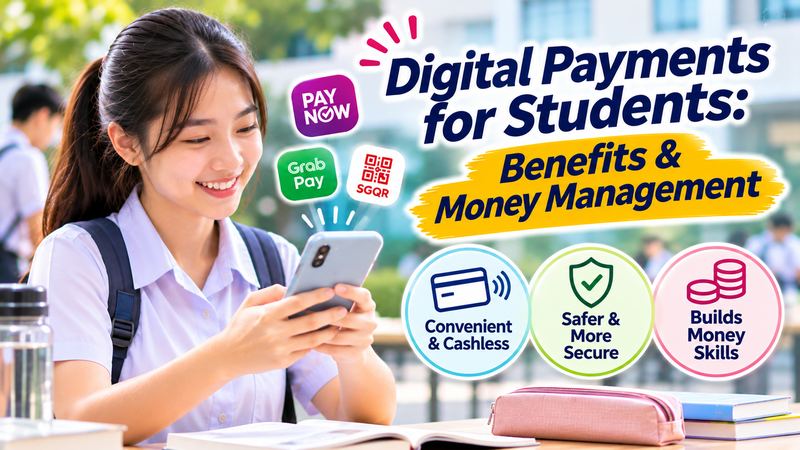
In Singapore, services such as PayNow, mobile banking, and QR-code payments have made cashless transactions part of everyday life. While these technologies offer convenience, they also raise important questions about responsible spending, financial literacy, and online safety.
Understanding how digital payments work can help students make better financial decisions and prepare for greater financial independence.
What Are Digital Payments for Students?
Digital payments are transactions made electronically without exchanging physical cash. Students can use supported payment applications, debit cards, prepaid cards, or bank transfers to pay for purchases and transfer money.
In Singapore, some common digital payment methods include:
- PayNow: Allows users of participating institutions to transfer money using registered identifiers such as mobile numbers.
- SGQR: A unified QR-code label that supports participating payment schemes.
- Mobile wallets: Allow eligible users to make electronic payments through compatible applications.
- Contactless cards: Enable payments by tapping a supported card or device on a payment terminal.
- Online banking: Provides access to balances, transfers, and transaction histories.
According to the Association of Banks in Singapore, PayNow facilitates instant Singapore-dollar transfers between participating banks and eligible payment institutions through the FAST payment infrastructure.
However, access to these services depends on factors such as age, parental consent, account eligibility, and the payment provider's terms.
7 Ways Digital Payments Are Changing Student Money Management
1. Making Allowance Management More Convenient
Traditionally, parents gave children weekly or monthly allowances in cash. Digital banking and payment services now offer another way to manage these transfers.
Parents can transfer money to an eligible account, while students can check their available balance using a banking application.
For example, a secondary school student receiving S$60 each week could allocate the allowance across meals, transport, savings, and personal spending.
Digital transfers also make it easier for parents to provide additional money when a genuine unexpected expense arises.
However, convenience should not mean unlimited access to funds. Agreeing on a regular allowance and clear spending expectations helps students understand financial boundaries.
2. Helping Students Track Their Spending
One of the biggest advantages of digital payments is the availability of transaction records.
When students spend cash, they may forget smaller purchases unless they record them manually. Digital accounts can provide a transaction history showing payment amounts, dates, and merchant details. This makes it easier to identify spending patterns.
Individually, these purchases may seem insignificant. Looking at the total can help students understand how frequent small expenses affect their budget.
According to Singapore's MoneySense financial education programme, tracking expenses and reviewing budgets regularly are important money management practices.
Digital transaction records can support these habits, provided students actually review them.
3. Encouraging Better Budgeting Habits
Digital payments can make budgeting more practical when students combine transaction tracking with clear spending limits.
A student could divide a weekly allowance into categories such as food, transport, savings, and discretionary purchases.
Consider this illustrative budget:
|
Expense Category |
Weekly Budget |
|
Food and drinks |
S$25 |
|
Transport |
S$10 |
|
Personal spending |
S$10 |
|
Savings |
S$15 |
|
Total allowance |
S$60 |
The amounts will vary depending on the student's age, school arrangements, and household circumstances.
The important lesson is deciding how money should be used before spending it.
Students can review their balances throughout the week and adjust discretionary purchases when necessary.
Rather than treating their account balance as money available for immediate spending, they learn to distinguish between money allocated for current expenses and money reserved for future needs.
4. Making Saving Goals Easier to Monitor
Digital banking tools can help students monitor their progress towards financial goals.
A student saving S15 each week can reach the goal in 16 weeks, assuming no interest or additional contributions.
Seeing savings accumulate can make financial progress more visible.
Depending on the banking provider, eligible accounts may support savings goals, scheduled transfers, or separate savings balances.
Parents can reinforce these habits by encouraging children to save for something meaningful rather than expecting immediate purchases.
MoneySense's guide on teaching children money management recommends introducing saving, spending decisions, and financial responsibility through everyday experiences.
The technology is useful, but the underlying lesson remains the same: saving requires consistency and patience.
5. Introducing Students to Cashless Financial Responsibility
Using digital payments can help students understand how modern financial systems operate.
They begin learning practical concepts such as available balances, transfer confirmations, payment references, and account security.
For example, a student making a PayNow transfer should understand why checking the recipient's displayed name matters before authorising payment.
Similarly, students should learn that a completed electronic transfer may not be easily reversible simply because they entered the wrong recipient details. These experiences help students develop financial judgment.
However, parents should introduce digital payment access gradually. Younger students may benefit from limited spending functionality and parental guidance, while older students can take on greater responsibility. Age-appropriate financial education is more valuable than simply giving children access to more payment features.
6. Changing How Students Shop and Make Everyday Payments
Digital payments have also changed the way students purchase goods and services.
Online learning materials, school supplies, food, and entertainment may be available through websites and applications that accept electronic payments. Cashless checkout can save time and reduce the need to carry physical currency.
However, this convenience introduces a behavioural challenge.
When students do not physically hand over money, repeated small purchases may feel less significant. Stored payment methods and quick checkout options can also make impulsive purchases easier.
A student buying a $3 snack online or through an application may focus on the convenience rather than the cumulative cost.
Developing a simple habit of checking the total price, including delivery charges and other fees, can help prevent unnecessary spending.
Digital payments should make transactions easier, not remove the need to think before purchasing.
7. Increasing the Importance of Online Payment Security
As students become more comfortable making digital transactions, understanding payment security becomes essential.
Scammers can impersonate sellers, educational institutions, banks, or familiar individuals to trick people into transferring money or disclosing sensitive information.
In April 2026, Singapore's ScamShield warned about fraudulent school and tuition fee payment requests in which scammers impersonated educational institutions.
These cases demonstrate why students and parents should independently verify unexpected payment instructions.
The following habits can help reduce risk:
- Never share banking passwords, one-time passwords, or confidential authentication details.
- Check the recipient's identity before confirming a transfer.
- Avoid scanning suspicious QR codes or opening payment links from unknown sources.
- Use official banking applications and trusted payment platforms.
- Enable available transaction notifications and appropriate security settings.
- Inform a parent or trusted adult immediately when a suspicious transaction occurs.
Singapore's ScamShield provides guidance on recognising phishing attempts and protecting banking information.
Students should also understand that a digital payment confirmation does not guarantee that an online seller is genuine.
Digital Payments vs Cash: Which Is Better for Students?
Both payment methods have advantages, and neither automatically produces better spending habits.
|
Factor |
Digital Payments |
Cash |
|
Expense tracking |
Transaction histories may be available |
Usually requires manual tracking |
|
Convenience |
Useful for supported online and in-person payments |
Useful where cash is accepted |
|
Budget awareness |
Requires regular balance reviews |
Physical cash can make remaining funds easier to see |
|
Security risks |
Scams, phishing, unauthorised access |
Loss or theft of physical money |
|
Parental oversight |
Some accounts provide spending controls |
Parents may monitor cash allowances manually |
|
Accessibility |
Requires compatible accounts, cards, or devices |
Does not require a digital account |
For younger students, a combination of cash and supervised digital payments may be appropriate.
Cash can help demonstrate the physical value of money, while digital payments introduce transaction records and online financial responsibility.
The right approach depends on the student's maturity, spending needs, and family preferences.
How Parents Can Teach Students to Manage Digital Payments Responsibly
Giving children access to digital payments should be accompanied by practical financial education.
Start With a Fixed Allowance
Agree on a weekly or monthly allowance based on realistic expenses. Avoid automatically replenishing funds whenever discretionary spending exceeds the budget.
Review Transactions Together
Set aside a few minutes each week to discuss purchases, savings, and unexpected expenses.
The objective is to encourage reflection rather than scrutinise every small transaction.
Teach the Difference Between Needs and Wants
Food, necessary transport, and essential school supplies generally take priority over optional purchases.
Understanding this distinction helps students make informed decisions when money is limited.
Set Appropriate Account Controls
Where supported, use transaction limits, alerts, and age-appropriate account features. Confirm the provider's requirements for minors.
Discuss Online Scams Openly
Teach students how to recognise suspicious payment requests and encourage them to seek help without hesitation.
Encourage Independent Decisions
Gradually allow students to make spending decisions within agreed limits.
Financial confidence develops through practice, reflection, and learning from manageable mistakes.
What Are the Challenges of Digital Payments for Students?
Although digital payments offer useful features, they also present limitations.
Overspending: Easy checkout and frequent small purchases can make it harder to recognise cumulative spending.
Dependence on devices: Payments may be unavailable when a phone has no battery, internet connectivity is insufficient, or systems experience disruptions.
Scam exposure: Students may encounter fraudulent sellers, payment requests, and impersonation attempts.
Privacy concerns: Digital transactions create records and involve personal information that should be protected.
Unequal access: Not every student has an eligible bank account, payment card, or suitable device.
These challenges reinforce the importance of teaching financial literacy alongside digital payment skills.
The Future of Digital Payments and Student Financial Literacy
As payment technology develops, students are likely to encounter more integrated digital financial experiences.
Transaction notifications, budgeting tools, account controls, and financial education features can help young users better understand everyday financial decisions.
Schools and parents also have an opportunity to connect financial literacy lessons with real-world activities.
For example, students could practise comparing prices, creating a weekly budget, examining sample transaction records, or identifying suspicious payment messages.
Such activities teach transferable financial skills without requiring students to open payment accounts.
Ultimately, the value of digital payments lies not simply in making transactions faster but in helping young people understand and manage money responsibly.
Conclusion
Digital payments are reshaping how students receive allowances, make purchases, track expenses, and save for future goals. In Singapore, services such as PayNow and QR-code payments have made electronic transactions increasingly accessible in everyday situations.
Yet technology alone cannot create good money management habits.
Students still need to understand budgeting, distinguish needs from wants, protect their financial information, and consider the consequences of spending decisions.
When combined with parental guidance and practical financial education, digital payments can become valuable tools for developing financial independence.
Frequently Asked Questions
How do digital payments help students manage money?
Digital payments can provide transaction histories, balance information, and spending notifications. These features help students track expenses, review budgets, and monitor savings goals.
Are digital wallets safe for students?
Digital wallets can offer security features such as authentication and transaction alerts, but they are not risk-free. Students should use eligible, trusted services, secure their devices, and verify payment requests.
What is the best way for students to manage their allowance?
Students can divide their allowance into essential expenses, personal spending, and savings. Reviewing expenses each week helps them understand whether they are following their budget.
Can students use PayNow in Singapore?
Eligible students may use PayNow through participating banks or payment institutions. Availability depends on the account provider, age requirements, account eligibility, and applicable parental consent arrangements.
Can digital payments help students save money?
Yes. Transaction histories and savings features can support financial planning. However, saving depends on consistently setting money aside and making responsible spending decisions.
Should students use cash or digital payments?
Both can be useful. Cash provides a tangible way to understand spending, while digital payments offer transaction records and electronic convenience. The appropriate combination depends on age, financial needs, and supervision.






Tutor City's blog focuses on balancing informative and relevant content, never at the expense of providing an enriching read.
We want our readers to expand their horizons by learning more and find meaning to what they learn.
Resident author - Mr Wee Ben Sen, has a wealth of experience in crafting articles to provide valuable insights in the field of private education.
Ben Sen has also been running Tutor City, a leading home tuition agency in Singapore since 2010.
