
 blog
blog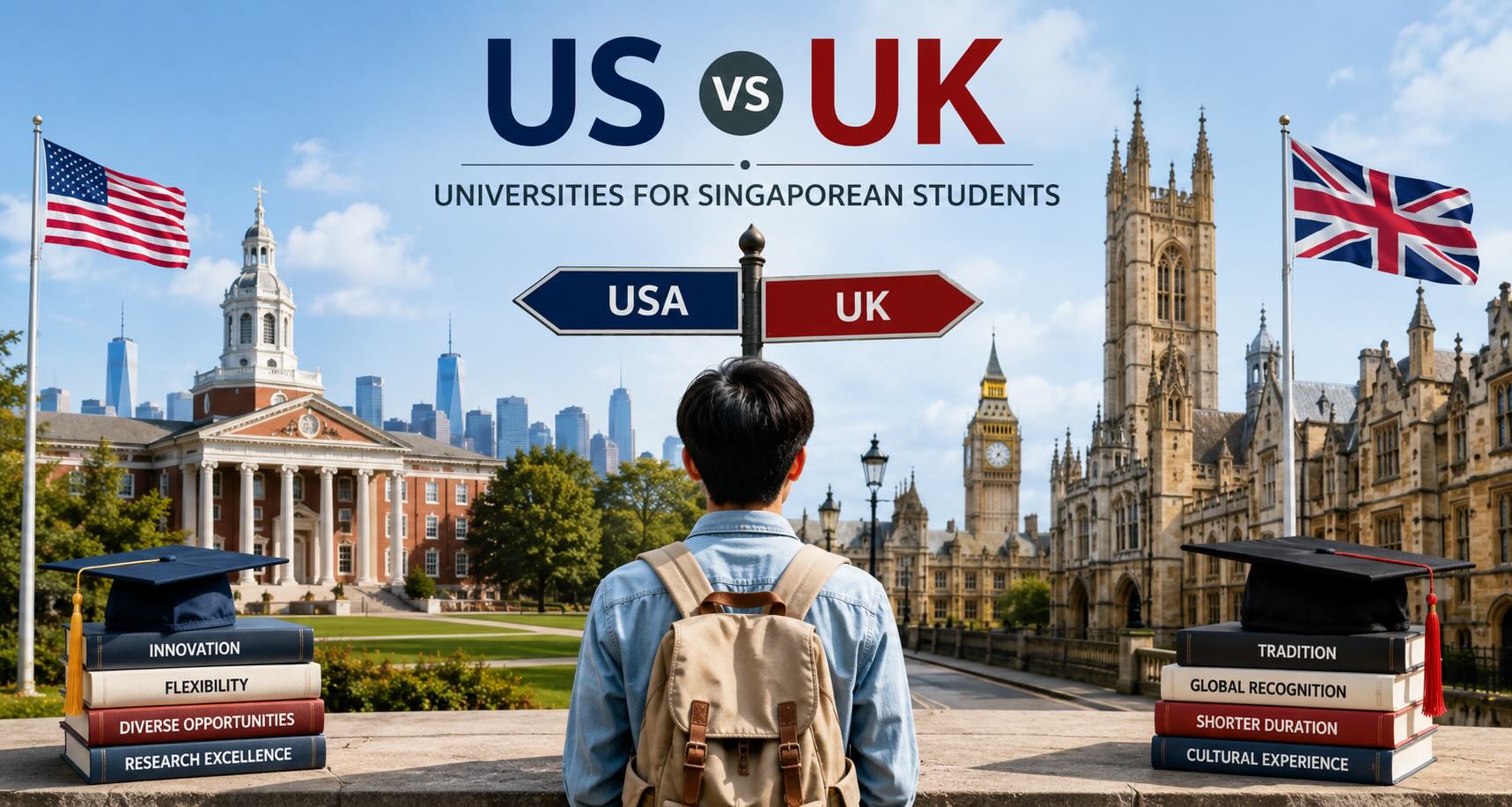
- Published by: Tutor City
- July 03, 2026
- Education
US vs UK Universities for Singaporean Students
For a country of its size, Singapore sends a remarkable number of students to the world’s most selective universities. Singaporeans are consistently among the largest groups of non-British undergraduates at Oxford and Cambridge, and the United States draws thousands more each year to the Ivy League, the great public research universities, and the small liberal arts colleges. For most families, the choice eventually narrows to a single question: the US or the UK?
There is no universal right answer. The two systems are built on genuinely different educational philosophies, and the better fit depends on the student, their intended subject, their budget, and what they want to do afterwards. This guide compares the two across the factors that matter most to Singaporean applicants and their parents.
Two different philosophies of the undergraduate degree
The single biggest difference is structural, and it shapes everything else.
A UK degree is specialised from day one. You apply to read a specific subject, law, engineering, economics, medicine, and you study almost nothing else for three years (four in Scotland, and four for some degrees with a placement or year abroad). There is little in the way of general education requirements; assessment often rests heavily on final examinations; and you graduate with an honours degree in your chosen field. Crucially, law and medicine are undergraduate degrees in the UK, so a student who already knows their path can qualify years earlier.
A US degree follows the liberal arts model. It runs for four years, and you typically spend the first two taking a broad spread of courses across the sciences, humanities and social sciences before declaring a major. You can change direction, combine a major with a minor, or double-major; assessment is continuous, through coursework, participation and a running GPA. Law and medicine are graduate degrees, pursued after a bachelor’s.
For Singaporean students, this distinction tends to sort itself out quickly. Those with a firm sense of direction, especially applicants to professional or highly technical subjects, often prefer the focus and efficiency of the UK. Those who want time to explore, or who are drawn to interdisciplinary study and the flexibility to pivot, are usually better suited to the US.
Popular destinations, and the Singaporeans who studied there
In the UK, the favoured destinations are predictable but well earned: Oxford and Cambridge above all, followed by the London institutions, LSE, Imperial College and UCL, alongside King’s College London, Warwick, Durham and Edinburgh. Law and medicine have long been especially popular choices among Singaporean students in Britain. Just how hard these places are to win is worth understanding before applying; a detailed breakdown of the Oxford and Cambridge admissions statistics shows the scale of the competition.
Given how fine the margins are at this level, many families now turn to specialist consultancies such as Clavis Education to help navigate the process from the personal statement through to interview.
In the US, Singaporean students cluster at the most prestigious names, Harvard, Stanford, MIT, the Ivies, the University of California campuses and Cornell, with finance, economics, computer science and engineering among the most common fields. A smaller but growing number choose the elite liberal arts colleges such as Williams and Amherst. For a sense of how the two countries’ leading institutions stack up globally, a look at the best universities in the world is a useful starting point.
Singapore’s own leaders illustrate both routes. Founding Prime Minister Lee Kuan Yew read law at Cambridge, as did former Prime Minister Lee Hsien Loong, who studied mathematics there before a later stint at Harvard. President Tharman Shanmugaratnam took his first degree in economics at the London School of Economics. On the US side, Olympic champion swimmer Joseph Schooling studied at the University of Texas at Austin while training for the medal he won in Rio, and former Prime Minister Goh Chok Tong pursued graduate study at Williams College. The acclaimed graphic novelist Sonny Liew captures the hybrid path neatly: philosophy at Cambridge, followed by an art degree in the United States. The point is not that one country produces better outcomes, but that both have long served Singaporeans exceptionally well.
Cost
Money is often the deciding factor, and here the comparison is less simple than sticker prices suggest.
UK international tuition, as a rough guide, runs from around £24,000 to £40,000 a year for most subjects (roughly S$41,000 to S$69,000), with clinical medicine higher and Oxford and Cambridge adding a college fee on top. But a UK bachelor’s lasts only three years, which meaningfully lowers the total.
US costs are higher and stretch over four years. At leading private universities, the all-in cost of attendance, tuition plus accommodation, fees and living, now commonly reaches around US$85,000 to US$95,000 a year (roughly S$110,000 to S$124,000). Large public universities are cheaper for international students but still substantial.
Two things complicate the arithmetic. First, the extra year and higher fees mean a US degree usually costs considerably more overall. Second, a handful of the wealthiest US universities offer generous need-based financial aid to international students, and a few are need-blind in admissions, which can make an elite US education dramatically cheaper, or even free, for a high-ability student from a lower-income family. The UK offers comparatively little financial aid to overseas undergraduates. For families paying full freight, the UK is typically the more economical choice; for exceptional students with financial need, the very top US institutions can occasionally be the most affordable option of all.
Campus life
The two countries offer quite different day-to-day experiences.
UK university life is more independent and city-integrated. Terms are short and intense, leaving long holidays; social life runs through student societies, the students’ union and, at Oxford, Cambridge and Durham, a college system that provides a built-in community. Students are treated as adults and left largely to manage their own time. What you will find less of is the all-encompassing “school spirit” of the American model.
US campus life is more immersive and structured. Most students live on a self-contained residential campus, big-time college sport draws real devotion, and there is a dense calendar of clubs, fraternities and sororities, and organised events. Pastoral and career support tends to be more hands-on, and the longer academic year keeps students on campus for more of it. For a student who wants a total, community-based experience, the US is hard to beat; for one who values independence and a shorter, sharper degree, the UK appeals.
Both countries are a long flight from home, and both have well-established Singaporean student societies that ease the transition.
Safety
Safety is a leading concern for Singaporean parents, and it is reasonable to weigh it honestly.
The UK has strict firearms laws and low levels of violent crime by international standards. The most common issues international students encounter are petty theft in large cities and the usual adjustments of living independently abroad. Britain also offers a significant practical advantage: student visa holders pay the Immigration Health Surcharge and can then use the National Health Service, which removes most healthcare cost worries.
The US picture is more varied. It depends heavily on the specific city and campus, and while the large majority of university campuses are safe and well-policed, the prevalence of firearms is a genuine differentiator that many Singaporean families factor in. Healthcare is also a real cost: US universities require students to carry private health insurance, which can add a few thousand dollars a year. None of this should be alarmist, most Singaporean students in the US have a safe and positive experience, but the two countries do present different risk profiles and different healthcare economics.
Employment opportunities
For students hoping to gain work experience abroad before deciding whether to return home, post-study immigration rules are decisive, and this is an area where the rules have been shifting.
The UK offers the Graduate Route, which lets graduates stay and work without needing employer sponsorship. It currently runs for two years for bachelor’s and master’s graduates (three for PhDs), but the government has confirmed it will be shortened to 18 months for applications made from 1 January 2027. After that window, graduates who want to remain must move onto a sponsored Skilled Worker visa.
The US allows Optional Practical Training (OPT) of 12 months after graduation, extended by a further 24 months for STEM graduates, giving up to three years of work in a STEM field. Beyond that, staying long-term generally means winning an H-1B visa, which is capped, allocated by lottery, and has recently become both costlier and less predictable, with new fees and a move toward wage-weighted selection.
Here, though, Singaporean students enjoy a genuine and often-overlooked advantage. Under the US–Singapore Free Trade Agreement, Singapore nationals have access to the H-1B1 visa, with 5,400 places set aside each year, entirely separate from the heavily oversubscribed main H-1B lottery. For a Singaporean graduate hoping to build a career in the United States, this is a meaningful edge that most other international students simply do not have.
Both a UK and a US degree are highly regarded by employers back in Singapore, and many students return home regardless of the route. Government scholarship holders, in particular, are usually bonded to return and serve.
What Singaporean students want, specifically
Underneath the comparisons, Singaporean applicants tend to prioritise a fairly consistent set of things:
- Brand and recognition. In a credential-conscious job market, the signalling power of a globally known university name carries real weight, which is part of why Oxbridge and the Ivy League loom so large.
- Value and return on investment. Families think carefully about total cost against outcomes, which often favours the shorter, cheaper UK degree unless substantial US aid is on the table.
- A clear pathway. Students set on law, medicine, finance, engineering or computing frequently prefer the directness of the UK system; those still exploring lean American.
- Networks and scholarships. Many top students are funded by government or corporate scholarships that steer them toward specific universities and carry a bond to return home.
- Safety, wellbeing and healthcare, which, as above, often tilts parental preference toward the UK.
- Options to stay on, where the US STEM work window and the Singapore-specific H-1B1 route can be attractive to those who want international experience.
Which should you choose?
The honest answer is that neither system is better; they are different, and the right choice is the one that fits the individual student. A focused future lawyer or doctor who wants to qualify efficiently and keep costs down will often be happiest in the UK. A student who wants to explore widely, values a vibrant residential campus, and may benefit from generous financial aid or a STEM career in the US will often be better served across the Atlantic.
What matters most is making the decision deliberately, with a clear view of the trade-offs, and starting early enough to prepare a strong application to whichever system you choose.






Tutor City's blog focuses on balancing informative and relevant content, never at the expense of providing an enriching read.
We want our readers to expand their horizons by learning more and find meaning to what they learn.
Resident author - Mr Wee Ben Sen, has a wealth of experience in crafting articles to provide valuable insights in the field of private education.
Ben Sen has also been running Tutor City, a leading home tuition agency in Singapore since 2010.
